





Why Does Zirconia Change Color or Translucency After Sintering?
 Sep 21, 2026|
Why Does Zirconia Change Color or Translucency After Sintering?
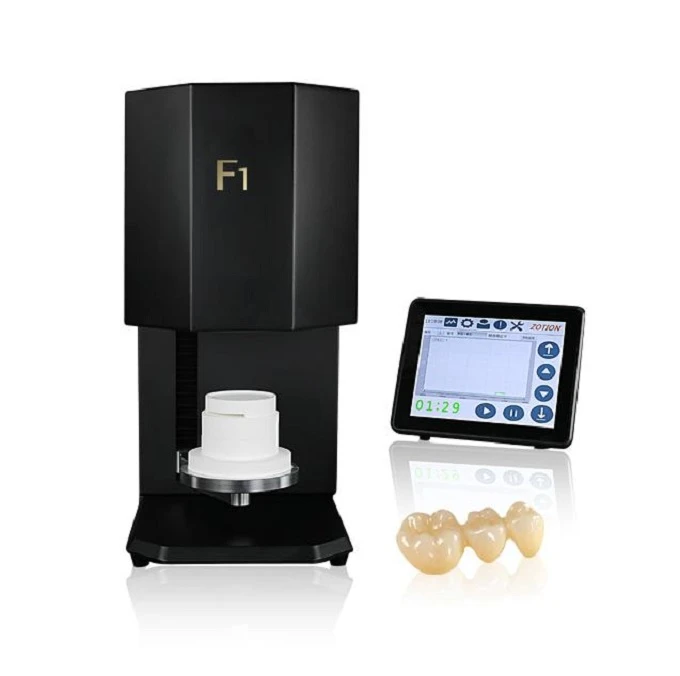
If you mill a zirconia restoration from a pre-sintered block and compare it with the same restoration after sintering, the difference is easy to notice.
The restoration becomes smaller, of course, but the visual change can be just as noticeable.
The color may become deeper or lighter. A multilayer zirconia may show a different transition between the cervical, body, and incisal areas. A restoration that looked relatively opaque before firing may become much more translucent after sintering.
Sometimes the opposite happens. A laboratory may use the same zirconia product and expect a similar optical result, but a different sintering cycle produces a restoration that looks slightly whiter, less transparent, or different in shade.
This leads to a common question:
Why does zirconia change color or translucency after sintering?
The answer is not simply "because it gets hotter."
The optical appearance of zirconia is related to several changes inside the material during processing. Grain structure, porosity, crystal phase, yttria content, pigments, material thickness, surface condition, and the sintering schedule can all affect what the eye sees.
For dental laboratories and distributors, this matters because a zirconia block should not be evaluated only by its appearance before milling. The more useful reference is the final material after it has gone through the complete manufacturing process.
Zirconia Does Not Have Its Final Optical Appearance Before Sintering
A pre-sintered zirconia disc or block is not simply a smaller version of the final ceramic.
Before final sintering, the material has a relatively porous compacted structure. During heating, the particles bond together, the pores are reduced, the density increases, and the microstructure changes.
Light interacts with this changing microstructure.
A zirconia restoration can therefore look quite different before and after firing.
Researchers studying dental zirconia commonly evaluate translucency using measurements such as the translucency parameter (TP) rather than relying only on visual inspection.
That distinction is useful in a laboratory.
If someone says:
"This zirconia looks more translucent."
That is a useful observation, but it is not the same as measuring its optical properties.
A spectrophotometer can quantify changes that are difficult to judge consistently with the naked eye.
A 2013 study on two commercial dental zirconias, for example, found that grain size and translucency changed significantly under different sintering conditions. The researchers measured total light transmission and observed grain sizes ranging from approximately 347 to 1512 nm in one zirconia and 373 to 1481 nm in another under the tested conditions.
The important point is not that a particular zirconia should have one of those grain sizes.
The point is that the microstructure is not fixed during processing.
The firing cycle can change the structure through which light travels.
Why Does Grain Size Affect Translucency?
Zirconia is made up of crystalline grains separated by grain boundaries. When light passes through the ceramic, it can be scattered at different interfaces inside the material.
The relationship is not as simple as saying "large grains are always better" or "small grains are always better."
It depends on the material's crystal structure, pores, refractive-index differences, phase composition, grain boundaries, and other variables.
The 2013 study mentioned above found a clear relationship between sintering conditions, grain size, and translucency. The authors explained that when grain dimensions become comparable with the wavelength range of visible light, light scattering can increase.
A later systematic review also summarized the role of grain boundaries and pores in zirconia's optical behavior. Porosity can be particularly important because the refractive index of air is very different from that of zirconia, creating additional opportunities for light scattering.
The furnace is not simply "making zirconia transparent."
It is changing the internal structure of the ceramic, and that structure determines how light is transmitted, scattered, reflected, and absorbed.
Porosity Is One Reason Zirconia Can Look Opaque
For a laboratory, porosity is an important part of the optical discussion.
Before final sintering, zirconia contains more open space between particles than the final dense ceramic.
As sintering proceeds, these spaces are reduced.
If residual pores remain, they can scatter light.
This is one reason incomplete densification can reduce translucency.
A systematic review of recent dental zirconia materials reported that pores are major contributors to light scattering and that even relatively low porosity can influence translucency when pore dimensions interact strongly with visible light.
This also explains why looking at the color of an unsintered zirconia block is not enough to judge its final optical performance.
A block can appear relatively pale or opaque before sintering and become substantially different after densification.
The same consideration applies when comparing the appearance of two zirconia brands before sintering. The final sintered restoration provides a much more meaningful basis for comparing shade and translucency.
Why Can a Higher Sintering Temperature Increase Translucency?
In many zirconia systems, increasing the sintering temperature promotes grain growth and densification.
Larger grains and reduced grain-boundary density can change how light travels through the material.
A 2011 study investigated zirconia made from powders with particle sizes of 40 and 90 nm and sintered specimens at 1350°C, 1400°C, 1450°C, and 1500°C. The researchers reported increases in sintered density and visible-light transmittance as the sintering temperature increased across that experimental range.
Another study examining highly translucent 3Y, 4Y, and 5Y zirconias found that increasing sintering temperature increased translucency in the 4Y-PSZ and 5Y-PSZ groups, while the change was not significant for the tested 3Y-TZP. All three materials showed grain enlargement with increasing temperature.
This is one reason zirconia should not be discussed as one single material.
The response of 3Y zirconia cannot automatically be used to predict what will happen with 4Y or 5Y zirconia.
The same furnace setting can produce different optical results depending on the material.
But Higher Temperature Does Not Mean "More Translucent" Forever
It would be too simple to say:
Higher temperature always makes zirconia more translucent.
That is not supported by the research.
A 2024 study examined four multilayer zirconia materials at temperatures 5% below, 2.5% below, at, 2.5% above, and 5% above the recommended firing temperature.
The results differed between materials.
For one material, higher temperature increased the translucency parameter. For another, higher temperature reduced it. The study found that material type, sintering temperature, specimen section, and their interactions affected the measured translucency.
Suppose two zirconia brands both recommend firing at around 1500°C.
Changing both programs by +30°C does not necessarily produce the same optical result.
The chemistry and microstructure of the two materials are different, so their response to heat can also be different.
Color and Translucency Are Not the Same Thing
A restoration can become more translucent without simply becoming "whiter."
Color and translucency describe different optical characteristics.
Color is commonly described using the CIE Lab* system:
L* represents lightness;
a* represents the red-green axis;
b* represents the yellow-blue axis.
Color difference can then be calculated using ΔE values, including the more recent CIEDE2000 method.
Translucency, meanwhile, describes how much light passes through a material compared with an opaque reference.
So when a laboratory says:
"The new batch looks different."
There are several possible explanations.
The restoration may have changed in lightness.
The chroma may have changed.
The hue may have shifted.
The translucency may have changed.
Several of these properties may also have changed at the same time.
Optical troubleshooting becomes easier when a laboratory uses standardized lighting and, where necessary, instrumental color measurement instead of relying only on visual memory.
Why Can the Same Zirconia Become Lighter or Darker After Sintering?
Colorants are part of the answer.
Modern dental zirconias are not always simply white powders.
Shaded and multilayer zirconias can contain coloring components that are introduced during manufacturing.
The thermal cycle can influence the final appearance of these materials.
A recent 2026 study investigated 3Y, 4Y, and 5Y zirconias in B1, A3, and C4 shades under conventional and high-speed sintering.
The researchers found that high-speed sintering reduced translucency and also changed the color coordinates. The high-speed groups showed higher L* values and lower a* and b* values, indicating a shift toward lighter, greener, and less yellow coordinates. The color difference was greatest in the C4-shaded specimens. The authors also associated some of the color change with Fe₂O₃ behavior and increased porosity.
This example shows that the optical effect of a firing cycle can depend on the shade of the zirconia, not only on its yttria content.
A dark A3 or C4 material should not automatically be expected to behave optically like a white B1 material under the same processing conditions.
Why Does Multilayer Zirconia Sometimes Show a Different Gradient After Sintering?
Multilayer zirconia adds another variable.
A multilayer block is not optically identical from top to bottom.
Different regions are manufactured to provide different color or translucency characteristics.
After milling, the position of the restoration within the multilayer structure determines which parts of the block become the cervical, body, and incisal areas of the final restoration.
The sintering process then changes the material again.
The 2024 study of four multilayer zirconias measured separate sections of the specimens and found that translucency differed between sections. It also found interactions between material type and sintering temperature.
A laboratory should therefore not judge a multilayer zirconia only by looking at one area of the disc.
A small difference in position can correspond to a different material layer.
For distributors, this is useful to explain to customers who are new to multilayer zirconia.
If the same restoration is moved several millimeters vertically in the CAD design, the final shade gradient can change even when the zirconia disc and sintering program remain unchanged.
That is not necessarily a furnace problem.
It can simply result from where the restoration was positioned within the material.
Thickness Changes the Optical Result Too
Imagine two crowns made from the same zirconia.
One has a 0.6 mm wall thickness in a particular region.
Another has a thickness of 1.2 mm.
They will not necessarily have the same translucency.
The reason is straightforward: light has to travel through different amounts of ceramic.
Material composition matters, but thickness matters as well.
A 2026 study specifically examined the effects of yttria content and specimen thickness on dental zirconia's optical properties, including color difference, translucency, spectral reflectance, and radiant transmittance. The researchers emphasized that both material composition and thickness affect the measured optical behavior.
This matters when comparing laboratory results.
If Lab A says:
"Our zirconia is more translucent than yours."
The comparison is not meaningful unless the specimens have comparable thickness, surface condition, shade, sintering procedure, and measurement conditions.
A 0.5 mm disc and a 1.5 mm disc made from the same zirconia should not be expected to transmit the same amount of light.
Surface Finish Can Also Change What the Eye Sees
Another common source of confusion is surface condition.
A zirconia restoration before polishing and the same restoration after polishing may not look identical.
Surface roughness changes the way light is reflected from the surface.
This can affect visual brightness and perceived translucency.
For this reason, when comparing zirconia materials in an internal laboratory test, I would keep the surface condition consistent.
For example:
same material + same thickness + same sintering cycle + same polishing procedure
is a meaningful comparison.
But:
material A polished + material B unpolished
is not.
The same problem appears when a laboratory compares a restoration immediately after sintering with another restoration after extensive external adjustment.
The optical result is no longer controlled by the sintering process alone.
What About the Crystal Phase?
Zirconia can exist in different crystal structures, and the balance between these phases influences its optical and mechanical behavior.
Yttria content changes the phase stability of zirconia.
This is one reason 3Y, 4Y, and 5Y materials cannot be treated as identical.
The relationship is relevant when discussing translucency because higher yttria contents are commonly associated with a larger cubic-phase fraction and greater translucency, while lower-yttria materials generally retain more tetragonal zirconia and higher strength.
However, even within one yttria category, the final optical result still depends on the processing conditions and the actual formulation.
Research on highly translucent 3Y, 4Y, and 5Y zirconias found that temperature changes produced different translucency responses between the groups. The 4Y and 5Y materials showed increases in translucency with higher sintering temperature in that experiment, while the 3Y material did not show a significant translucency change.
For that reason, I would not recommend giving a laboratory a generic statement such as:
"Increase the temperature if you want more translucency."
The material has to be considered first.
A Real Example: 1400°C vs 1500°C
A 2025 study investigated four translucent zirconia materials at 1400°C, 1450°C, and 1500°C, followed by aging protocols.
There was a particularly clear result:
The 1400°C condition produced the greatest color difference, with a reported ΔE00 value of 5.25.
The authors concluded that sintering at a lower temperature than recommended could reduce lightness and increase saturation and opacity, particularly after aging.
This puts a number on something that is otherwise easy to describe vaguely.
Instead of saying:
"Incorrect temperature can change the color."
we can say:
In one in-vitro study, a 1400°C firing condition produced a ΔE00 of 5.25 compared with the reference condition.
That does not mean every zirconia will show a ΔE00 of 5.25 at 1400°C.
It was one study, using specific materials and conditions.
The result does, however, demonstrate that the difference can be measurable rather than merely theoretical.
Why Two Dental Labs Can Get Different Optical Results From the Same Zirconia
This is a common question from distributors.
Suppose two laboratories purchase exactly the same zirconia disc.
Lab A reports excellent translucency.
Lab B says the same material looks too opaque.
Before assuming that one laboratory received a defective batch, I would compare the entire process.
Material
Is it the same product?
Same shade?
Same lot?
Same layer position?
CAD design
Is the restoration thickness similar?
Was it positioned at the same height within a multilayer disc?
Milling
Was the restoration milled under similar conditions?
Was there contamination or excessive surface damage?
Sintering
Was the same program used?
Was the furnace properly maintained?
Surface finishing
Were both restorations polished in the same way?
Measurement
Were they evaluated under the same lighting conditions?
These questions are more useful than simply comparing the product names.
Optical performance is a process result.
What Should a Laboratory Do When a New Batch Looks Different?
I would not immediately change the sintering temperature.
Start with a controlled comparison.
Take a zirconia block from the new batch and, if possible, retain a sample from the previous batch.
Then keep the following constant:
same CAD file;
same restoration thickness;
same shade;
same milling machine;
same milling parameters;
same sintering furnace;
same sintering program;
same polishing method.
Only change the material batch.
If the optical difference remains, the material itself becomes a stronger suspect.
If the material is unchanged but the furnace is different, repeat the test using the same zirconia on both furnaces.
This kind of A/B testing is much more useful than changing several variables simultaneously.
For a manufacturer, this is also the type of information that helps when a customer reports:
"The zirconia color is different after sintering."
Without the product name, batch number, program, furnace information, specimen thickness, and photos, it is difficult to determine whether the problem comes from the material or the process.
What Should Distributors Know About Zirconia Color Claims?
When selling zirconia to overseas laboratories, optical claims need a clear reference.
A product specification may state:
"High translucency."
That description alone is not enough for a laboratory to predict the final result.
A distributor should be able to explain:
what zirconia composition is used;
whether the product is 3Y, 4Y, 5Y, or a gradient/multilayer material;
whether the block is white, pre-shaded, or multilayer;
recommended sintering conditions;
typical thickness used for optical testing;
whether translucency data were measured instrumentally;
how the shade was evaluated;
whether the reported value applies to the whole disc or a particular layer.
This does not mean every sales document needs a page of laboratory measurements.
The technical claim simply needs a clear reference.
For example, saying:
"TP = XX"
without specifying thickness and test conditions does not tell a laboratory very much.
The same zirconia can give a different TP value at different thicknesses.
Can Speed Sintering Change Color?
Yes, but the answer depends on the material and the specific speed-sintering program.
This area has become more relevant as laboratories look for shorter production cycles.
A 2026 study compared conventional sintering of approximately 12 hours with a high-speed protocol of approximately 18 minutes using 3Y, 4Y, and 5Y zirconias in B1, A3, and C4 shades.
The high-speed protocol significantly reduced translucency and produced measurable color changes. The effect was especially pronounced in darker C4 specimens, while the researchers also observed changes associated with porosity and Fe₂O₃ content.
However, this should not be interpreted as:
"Speed sintering always makes zirconia worse."
Other studies have reported different results under different materials and protocols.
For example, a study of rapid-sintered translucent zirconia found that color differences between conventional and rapid sintering were clinically acceptable in the tested materials, while the effect on translucency depended on the specific zirconia group.
The practical point is that a sintering program needs to be validated for the particular zirconia.
A speed program developed for one material should not automatically be copied to another.
What Should a Laboratory Record When Investigating Color Differences?
If a laboratory wants to find the cause rather than simply adjust the furnace until the result looks better, I would record at least these items:
Material
manufacturer;
product name;
shade;
lot number;
multilayer position.
CAD/CAM
restoration type;
minimum thickness;
position in the disc;
milling machine.
Sintering
furnace model;
program name;
peak temperature;
holding time;
total cycle;
date of last maintenance.
Finishing
staining or coloring procedure;
polishing;
glazing, if applicable.
Evaluation
lighting condition;
reference shade tab;
specimen thickness;
spectrophotometer data, if available.
This may seem excessive for one crown.
It is not excessive when a laboratory is trying to understand why 50 or 100 restorations suddenly look different.
Good records turn an argument about "bad zirconia" into a technical investigation.
The Main Point: Sintering Does Not Just Change the Size of Zirconia
When zirconia comes out of a furnace, its optical appearance reflects changes inside the material.
The main variables include:
density;
residual porosity;
grain structure;
crystal phase;
yttria content;
pigments;
material thickness;
multilayer position;
surface condition;
sintering temperature;
holding time;
heating schedule.
Research has repeatedly shown that these variables can affect translucency and color. Studies have measured changes in TP, ΔE00, grain size, density, phase composition, and light transmission under different sintering conditions.
For laboratories, the practical lesson is not to look for one universal "best" sintering temperature.
Instead, use the firing program provided for the specific zirconia and keep the processing conditions consistent.
If the final restoration suddenly looks different, investigate the process before changing it.
Check the material.
Check the batch.
Check the thickness.
Check the position within a multilayer disc.
Check the furnace program.
Check the furnace condition.
Check the surface finish.
If the difference is important enough, measure the optical properties rather than relying only on visual judgment.
For distributors, the same principle applies when comparing zirconia products.
A higher translucency number on a brochure does not automatically mean that the restoration will look the same in every case. Thickness, shade, material composition, and processing conditions all affect the final appearance.
From the manufacturing side, zirconia and sintering equipment should therefore be considered together.
The furnace does not create the optical properties by itself, and the zirconia block does not determine the final appearance by itself.
The final result comes from the interaction between the material, CAD design, milling, sintering, and finishing process.
That is easy to miss when zirconia is compared using only a single number such as strength or translucency.
A laboratory does not deliver a zirconia block to the patient.
It delivers a finished restoration.
The optical properties that matter are the properties of that final restoration after the material has gone through the complete production process.