





What Is PMMA Used for in Dentistry?
 Sep 21, 2026|
What Is PMMA Used for in Dentistry?
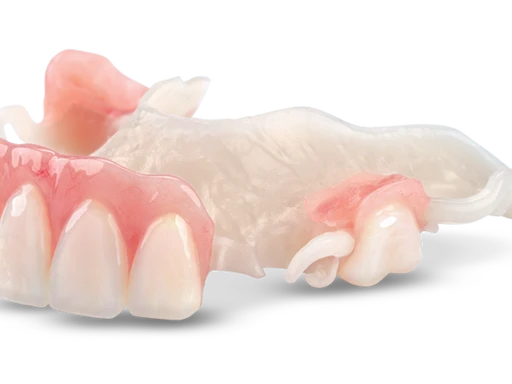
When people hear "PMMA" in dentistry, the first thing that often comes to mind is a temporary crown.
That is understandable. PMMA has been used for temporary crowns and bridges for many years, and CAD/CAM PMMA discs are now common in digital dental laboratories.
But temporary crowns are only one part of the story.
PMMA is used in several areas of dentistry, including denture bases, artificial teeth, provisional crowns and bridges, implant provisional restorations, orthodontic retainers, occlusal splints, denture repairs, obturators, and digitally produced dental components.
The continued use of PMMA in dental laboratories is related to its processing characteristics and the range of applications it can support. It can be processed through conventional laboratory techniques, milled from pre-manufactured blanks, or used in some additive manufacturing workflows.
For a dental laboratory or distributor, this distinction matters.
A PMMA disc sold for a provisional crown should not automatically be treated as equivalent to a PMMA material intended for a denture base. They may belong to the same polymer family, but the formulation, manufacturing method, indication, and testing requirements can be different.
So when someone asks, "What is PMMA used for in dentistry?", the answer is broader than "temporary teeth."
1. PMMA for Temporary Crowns
One of the most common applications of PMMA is the fabrication of provisional crowns.
After a tooth is prepared for a definitive crown, the patient may need to wait while the final restoration is being manufactured. A provisional crown can cover the prepared tooth during this period.
The provisional restoration has several practical functions.
It can help protect the prepared tooth, maintain the position of neighboring teeth, provide an acceptable appearance, and allow the dentist to evaluate the occlusion and tooth shape before the definitive restoration is placed.
PMMA is useful here because it can be shaped and adjusted relatively easily.
For example, if a provisional crown is slightly high in occlusion, the technician or dentist can adjust it without replacing the entire restoration.
The same applies to proximal contacts and contour.
A provisional restoration does not necessarily need to have the same material characteristics as the definitive restoration. Its requirements depend on how long it will be used and what function it needs to perform.
A review of PMMA applications describes temporary crowns and fixed partial dentures as established dental uses of PMMA, while also noting that conventional PMMA has limitations in fracture resistance and wear resistance for more demanding situations.
A temporary restoration is still exposed to chewing forces, so mechanical performance remains relevant even when the restoration is intended for short-term use.
2. PMMA for Provisional Bridges
PMMA is also used to fabricate provisional bridges.
This application can place greater demands on the material than a single crown.
A single crown is supported by its own tooth structure. A bridge contains multiple units connected through pontics and connectors.
The technician therefore needs to consider both the material and the bridge design.
For example, imagine a three-unit provisional bridge.
The material may have acceptable properties for individual crowns, but the connector area becomes a critical part of the restoration.
If the connector is too thin, if there are sharp internal transitions, or if the bridge is exposed to heavy occlusal loading, the risk of fracture increases.
A laboratory should therefore look beyond a general statement such as "suitable for crowns and bridges."
Useful questions include:
What bridge span has been tested?
Is the material intended for short-term or longer-term provisional use?
Are implant-supported bridges included in the indication?
What connector dimensions are recommended?
Are there specific milling guidelines?
These details provide more useful information than a general description such as "high strength."
3. PMMA for Long-Term Provisional Restorations
Some provisional restorations need to remain in place much longer than a normal short transitional period.
This can occur in cases involving extensive rehabilitation, implant treatment, occlusal reconstruction, or staged treatment.
The provisional restoration may remain in use while the dentist evaluates function and aesthetics before moving to the final restoration.
CAD/CAM PMMA has expanded the options available for these cases.
A systematic review of CAD/CAM materials reports that improvements in the mechanical properties of CAD/CAM PMMA have allowed some products to be used for long-term provisional restorations, including applications reported for periods of up to one year.
That does not mean every PMMA disc can remain in the mouth for one year.
"PMMA" describes a polymer family. The clinical indication belongs to the specific product.
If a manufacturer has not indicated a disc for long-term intraoral use, the laboratory should not infer that indication from the material name or from a strength value alone.
4. PMMA for Implant Provisional Restorations
Implant dentistry creates another application for PMMA.
After implant placement, the patient may need a provisional restoration before the definitive prosthesis is completed.
Depending on the clinical situation, PMMA can be used to fabricate provisional implant-supported crowns, bridges, or larger temporary structures.
The requirements can be more demanding than those for a simple tooth-supported temporary crown.
There may be multiple implant connections, longer spans, more complicated occlusion, and greater functional loading.
A full-arch implant provisional is a good example.
A laboratory may mill a large PMMA structure, finish it, attach the necessary components, and deliver it for clinical evaluation.
In this situation, material selection cannot be separated from restoration design.
A manufacturer may provide a disc with good laboratory test data, but the laboratory still needs to follow the material's stated indication and use an appropriate digital design.
Cost also involves more than the price of the disc.
If a provisional restoration fractures and has to be remade, the laboratory has used additional material, machine time, technician time, and possibly delivery time.
5. PMMA for Full-Arch Provisional Restorations
Full-arch provisional restorations are another area where PMMA can be useful.
These cases can involve extensive restorative treatment, full-mouth rehabilitation, or implant-supported treatment.
The technician may need to reproduce the patient's existing occlusion while also changing tooth position, tooth shape, or vertical relationships.
PMMA is useful in this situation because it can be modified relatively easily.
A provisional restoration can function as a trial version of the proposed treatment.
For example, the dentist may want to evaluate whether:
the patient can tolerate a new occlusal arrangement;
the tooth length looks appropriate;
speech is acceptable;
the anterior tooth position is satisfactory;
the patient is comfortable with the general appearance;
the occlusion needs further adjustment.
If changes are needed, they can be made to the provisional restoration before the definitive prosthesis is manufactured.
This gives the clinical and laboratory team an opportunity to evaluate the proposed design under actual conditions.
6. PMMA for Diagnostic Restorations and Mock-Ups
PMMA can also be used when the purpose of the restoration is evaluation rather than long-term service.
A diagnostic restoration can help the dentist and patient visualize a proposed change in tooth shape or arrangement.
For example, suppose a patient is considering changes to the length of the anterior teeth.
A digital design can be converted into a physical provisional restoration or another trial form.
The dentist can then evaluate the result in the patient's mouth.
This can reveal problems that are difficult to identify on a computer screen.
The patient may find that the proposed tooth length feels unusual.
The dentist may notice that the relationship between the upper and lower teeth needs adjustment.
The laboratory may find that a particular contour does not produce the expected emergence profile.
The provisional material gives the team an opportunity to identify these issues before the definitive restoration is manufactured.
7. PMMA for Denture Bases
PMMA has another major role in removable prosthodontics.
It is widely used for denture bases.
A denture base provides the foundation that supports the artificial teeth and contacts the oral tissues.
Traditional denture fabrication has commonly used PMMA-based materials processed through conventional laboratory techniques.
Digital dentistry has introduced another route. The denture base can be produced using CAD/CAM milling or additive manufacturing.
The current ISO framework for denture base polymers covers materials used in both additive and subtractive manufacturing. ISO 20795-1:2013 remains the published standard, while a new revision, ISO/DIS 20795-1, is under development and includes newer processing approaches.
For distributors, this means that "denture PMMA" is no longer limited to the traditional powder-and-liquid workflow.
Digital denture production has created additional categories of PMMA products with different manufacturing routes.
8. PMMA for Digitally Milled Dentures
In a conventional denture workflow, polymerization takes place as part of the laboratory fabrication process.
In a CAD/CAM workflow, the manufacturer can produce a pre-polymerized disc or blank, and the laboratory mills the denture base from that material.
A 2025 systematic review comparing conventional and digital denture bases noted that conventional PMMA processing can introduce polymerization shrinkage, internal stresses, and dimensional variation, while digital manufacturing can reduce some of these dimensional issues.
The review was based mainly on in-vitro studies, so these findings should not be interpreted as proof that every digital denture performs better clinically.
For a laboratory, the practical advantage is consistency.
If a technician is producing many dentures, the base material needs to behave predictably from one case to another.
This includes fit, machining behavior, shade, surface quality, and the ability to reproduce the digital design.
9. PMMA for Artificial Teeth
PMMA is also used in the manufacture of artificial teeth.
Artificial denture teeth need to provide an acceptable combination of appearance, shape, machinability, and resistance to the conditions they encounter in service.
PMMA-based artificial teeth have been used in dentistry for decades.
A review of prosthodontic applications lists artificial teeth among the established uses of PMMA, together with denture bases, temporary crowns, orthodontic retainers, and other prosthetic applications.
For manufacturers, the challenge is not simply making a tooth-shaped piece of acrylic.
The material has to be processed consistently enough to reproduce shade and morphology, while the final tooth needs to be compatible with the denture base and the intended clinical use.
For distributors, it is useful to distinguish between:
PMMA for milling
and
PMMA used as a conventional artificial-tooth material.
They may have very different production methods even though they belong to the same polymer family.
10. PMMA for Denture Repair
Acrylic denture bases can sometimes fracture.
Repairing an existing denture can be more practical than making an entirely new one, depending on the clinical situation.
PMMA-based repair materials have therefore been used in dental laboratories for many years.
The repair process may involve repositioning the broken pieces, preparing the fractured surfaces, adding new acrylic material, and finishing the repaired area.
Repair PMMA is not necessarily identical to a CAD/CAM denture disc.
A technician should follow the instructions for the particular repair system.
This distinction matters when a distributor supplies several acrylic products.
A customer asking for "PMMA" may actually be looking for a denture-base material, a repair acrylic, an artificial-tooth material, or a milling disc.
Those are different product requirements.
11. PMMA for Orthodontic Retainers
PMMA and acrylic-based materials are also used in orthodontic appliances.
One example is the acrylic component of removable orthodontic retainers.
The material provides the rigid acrylic body that works together with wires or other components.
A review of PMMA's dental applications lists orthodontic retainers among its established uses.
This application is quite different from milling a temporary crown.
The laboratory may be more concerned with adaptation, finishing, comfort, and dimensional accuracy than with high fracture strength.
For distributors, the purchasing criteria should follow the specific appliance and its intended use.
12. PMMA for Occlusal Splints
PMMA is also used in some occlusal appliances and splints.
An occlusal splint can be used to modify the contact relationship between the upper and lower teeth.
The appliance may be used in different clinical situations, so the exact material requirements depend on the appliance design and indication.
For the laboratory, surface quality is one consideration.
The technician needs to create a smooth surface that can be adjusted accurately and polished properly.
Occlusal contacts also need to be controlled carefully.
A splint that is poorly adjusted cannot be corrected simply by using a material with good mechanical properties. Design and finishing remain part of the result.
13. PMMA for Obturators and Maxillofacial Prostheses
PMMA is not limited to conventional dental restorations.
It has also been used in maxillofacial prosthetics.
An obturator, for example, may be used to close an opening in the palate after surgery or because of a congenital condition.
PMMA can provide the rigid framework or prosthetic component needed in these situations.
The clinical requirements are different from those of a temporary crown.
The shape may be complex, the prosthesis may need to be lightweight, and patient comfort becomes an important consideration.
A review of PMMA applications includes obturators for cleft palate and maxillofacial applications among the documented uses of the material.
14. PMMA for Dental Models and Dies
Another less visible use is the production of dental models and dies.
Digital workflows can use polymer materials for printed or milled models used during treatment planning and laboratory procedures.
PMMA has been reported for printed or milled casts and dies for treatment planning.
The requirements are different again.
A model does not need to remain in a patient's mouth.
Instead, the laboratory may care more about:
dimensional accuracy;
surface detail;
machining time;
edge stability;
resistance to handling;
cost per model.
These requirements can make PMMA useful for laboratory applications where the material does not need to meet the same requirements as an intraoral restoration.
15. PMMA in Research and Dental Testing
PMMA is also used outside routine patient treatment.
Researchers use PMMA in laboratory studies involving dental materials.
For example, tooth specimens may be embedded in polymer materials so that they can be sectioned, tested, or handled during experiments.
PMMA has also been used in laboratory models and research procedures.
This is not usually a major commercial application for dental distributors, but it illustrates another use of the material.
Its usefulness in these settings is partly related to its relatively straightforward processing and the ability to produce shapes and structures with controlled dimensions.
16. Why Is PMMA Commonly Used in Provisional Dentistry?
A reasonable question is:
Why not use the same material for every temporary restoration?
Provisional dentistry involves different requirements.
A single anterior crown may require good appearance and easy adjustment.
A posterior bridge may require greater resistance to fracture.
An implant-supported full-arch provisional may involve a different design and material selection process.
A long-term provisional may remain in the mouth for months.
A diagnostic restoration may only need to remain functional long enough for the dentist to evaluate the treatment.
These applications do not place the same demands on the material.
The intended use and expected service period should therefore be considered when selecting a PMMA product.
17. A Practical Example: One Laboratory, Three PMMA Applications
Imagine a dental laboratory that produces three types of work:
Case A: Single Temporary Crown
The laboratory needs quick milling, clean margins, good shade, and easy polishing.
Case B: Three-Unit Provisional Bridge
Connector design and fracture resistance become more important.
Case C: Full-Arch Implant Provisional
The laboratory needs to consider much more than the disc itself. Restoration geometry, implant connections, framework design, occlusion, material indication, and finishing all become relevant.
The laboratory may use PMMA for all three cases, but the testing criteria and product requirements are not necessarily the same.
This is why application-specific testing is useful when evaluating different PMMA products.
18. How Should a Laboratory Choose PMMA for a Particular Job?
A simple decision process can help.
First, identify the restoration.
Is it:
a single provisional crown?
a bridge?
an implant provisional?
a full-arch provisional?
a denture base?
an artificial tooth?
an orthodontic appliance?
an occlusal splint?
Then identify the expected service period.
A restoration intended to remain in place for several days has different requirements from one intended for several months.
Next, check the manufacturer's stated indication.
After that, review the technical data.
Finally, test the material under the laboratory's own working conditions.
This last step is often overlooked.
A technical datasheet cannot tell you everything about milling performance, finishing time, tool wear, or the appearance of the finished restoration.
19. A Small Milling Trial Can Reveal a Lot
Suppose a laboratory wants to compare two PMMA discs.
Instead of ordering a large quantity immediately, the laboratory could produce several identical temporary crowns from each material.
For example:
5 crowns from Material A
5 crowns from Material B
The technician can record:
milling time;
visible edge damage;
margin quality;
bur condition;
polishing time;
adjustment time;
final surface appearance.
Imagine the results look like this:
| Test item | Material A | Material B |
|---|---|---|
| Average milling time | 17 min | 19 min |
| Finishing time | 6 min | 8 min |
| Adjustment time | 3 min | 3 min |
| Total technician time | 26 min | 30 min |
The difference is 4 minutes per restoration.
For one crown, that may not matter.
For 15 crowns per day:
15 × 4 = 60 minutes per day.
Over 20 working days, that is about 20 hours of technician time per month.
These numbers are only an example. A real laboratory should replace them with its own measurements.
The purpose of this type of trial is not to declare one material universally better. It allows the laboratory to see how a particular material behaves in its own workflow.
20. What Should Distributors Know About PMMA Applications?
For a distributor, product classification is especially important.
A customer may say:
"I need PMMA."
That sentence is not specific enough.
A distributor should first ask:
What are you using it for?
If the customer produces temporary crowns, the distributor should look at provisional PMMA.
If the customer manufactures digital dentures, the distributor should check denture-base indications.
If the customer produces full-arch implant provisionals, a material intended only for short-term single crowns may not be appropriate.
If the customer wants artificial teeth, the product category is different again.
Understanding the application helps narrow down the appropriate product category before technical specifications are compared.
21. What Documents Should a Distributor Request?
Before introducing a PMMA product to dental laboratories, a distributor should ideally have access to:
technical data sheet;
intended use;
instructions for use;
available sizes;
available shades;
compatibility information;
mechanical test data;
regulatory documentation;
storage requirements;
shelf life;
batch information;
recommended milling parameters.
For denture-base materials, the relevant standard framework is particularly important.
ISO 20795-1 addresses requirements and test methods for denture-base polymers, including properties such as flexural behavior, impact resistance where applicable, residual methyl methacrylate monomer, water sorption, and solubility.
A distributor does not need to be a polymer scientist.
The distributor does, however, need to understand the product's intended use and the documentation that supports it.
22. PMMA Is Not Automatically Interchangeable Between Applications
A PMMA disc for temporary crowns is not automatically a denture-base disc.
A denture-base PMMA is not automatically suitable for an implant provisional.
A material used for an orthodontic retainer should not automatically be recommended for a long-term bridge.
The polymer name is only the starting point.
Formulation, processing method, indication, and testing all contribute to whether a particular product is appropriate for a given application.
The same principle applies to many other dental materials.
"Ceramic" does not describe one single material.
"Composite" does not describe one single material.
And "PMMA" does not describe one single dental product.
23. Where Does CAD/CAM PMMA Fit Into Modern Dental Laboratories?
Digital dentistry has changed how PMMA is processed.
Instead of manually forming the restoration, the laboratory can design it digitally and mill it from a pre-manufactured blank.
This has opened up applications that can be difficult to manage efficiently with traditional techniques.
For example, a laboratory can save a digital design, reproduce a provisional later, modify the design, and mill another version without starting the design process again.
This can be useful in complex rehabilitation cases.
The laboratory can also standardize certain production steps across multiple technicians.
A 2023 systematic review of CAD/CAM materials identified PMMA among the materials used in prosthodontic applications and reviewed evidence covering mechanical properties, composition, optical properties, and clinical indications.
Digital PMMA does not replace conventional acrylic in every situation.
It provides another manufacturing route, with different processing characteristics and workflow considerations.
24. What PMMA Cannot Do Should Also Be Understood
A useful discussion about PMMA should include its limitations.
PMMA is not a universal replacement for ceramic.
It is not automatically appropriate for permanent restorations simply because a particular PMMA has a relatively high strength value.
Traditional PMMA can also have limitations related to fracture, wear, water interaction, and residual monomer, depending on the material and processing method.
Research reviews continue to describe these limitations while also reporting modifications such as reinforcement with fibers and other materials.
The indication therefore needs to be checked for the exact product.
The laboratory should not extend a product's indication based only on its appearance or a single mechanical value.
25. Looking at PMMA From the Manufacturer's Side
From an R&D perspective, the interesting part of PMMA is not simply producing a disc with the correct diameter.
The manufacturer also needs to consider how the material will behave after it reaches the laboratory.
For a CAD/CAM PMMA disc, that means considering questions such as:
Will the disc machine consistently?
Will the margin remain clean during milling?
Will the shade remain consistent between batches?
Will the material polish in a predictable way?
Will the disc maintain dimensional stability during storage?
Will different thicknesses behave consistently?
Can the laboratory reproduce the same result with another batch?
These are practical manufacturing questions.
A material can look good on a specification sheet and still create problems in a real laboratory if production consistency is poor.
26. The Same PMMA Can Have Different Commercial Value
Suppose two manufacturers sell PMMA discs at different prices.
The first disc costs $10.
The second costs $12.
At first glance, the $10 disc appears cheaper.
But imagine the first material requires 6 additional minutes of finishing per restoration.
If a technician's effective labor cost is $20 per hour, those six minutes represent:
6 ÷ 60 × $20 = $2 of labor per restoration.
The apparent $2 material saving has already disappeared.
Again, this is only an example.
Every laboratory has a different labor cost, workflow, and production volume.
The point is that material price should be considered together with processing time.
For a high-volume laboratory, even small differences can accumulate.
27. A Practical Checklist for PMMA Buyers
Before buying a PMMA product, a laboratory can ask:
1. What exactly is this material intended for?
2. Is it conventional acrylic, a CAD/CAM disc, or a printable resin?
3. Is it indicated for short-term or long-term provisional use?
4. Can it be used for bridges or implant provisionals?
5. What disc sizes are available?
6. Which milling systems are compatible?
7. What are the recommended milling parameters?
8. What technical test data are available?
9. Is there batch traceability?
10. Can I test a small quantity before placing a larger order?
The last question is useful because a laboratory's own milling machine and finishing workflow provide practical information that a general datasheet cannot fully capture.
Conclusion
PMMA has a much broader role in dentistry than temporary crowns alone.
It can be found in provisional crowns and bridges, implant provisional restorations, full-arch provisionals, diagnostic restorations, denture bases, artificial teeth, denture repairs, orthodontic retainers, occlusal appliances, obturators, and various laboratory or research applications.
The growing use of CAD/CAM has also changed how PMMA is processed. Pre-manufactured blanks allow laboratories to mill restorations and denture components from industrially produced material, while newer digital workflows also include additive manufacturing.
For dental laboratories, the main consideration is not simply whether a PMMA product is inexpensive or easy to process.
Different PMMA products are made for different applications, and the relevant requirements can vary considerably between a temporary crown, a denture base, an implant provisional, and an orthodontic appliance.
From the manufacturing side, we also look at PMMA in practical terms.
The question is not only whether the material meets a specification on paper. It is whether the laboratory can mill it consistently, finish it efficiently, obtain predictable results, and use it within the product's stated indication.
That is where PMMA continues to have a place in modern dentistry.
It is not one material for one job. It is a polymer family used across different dental applications, with the formulation, processing method, product indication, and laboratory workflow determining how a particular PMMA material should be used.