





What Is a Zirconia Block?
 Sep 14, 2026|
What Is a Zirconia Block?
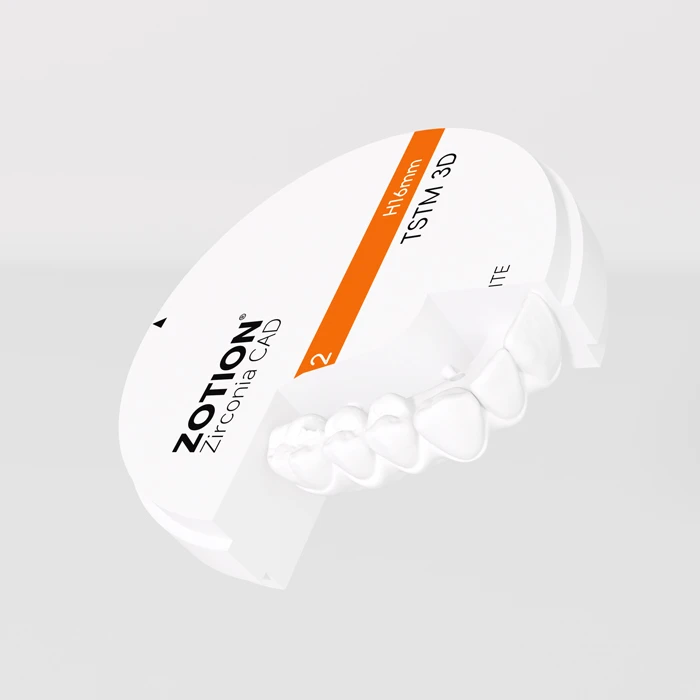
If you work in a dental laboratory, you have probably seen zirconia blocks many times. They usually look simple: a white or colored disc, with a hole or groove for the milling holder, and a small label showing the material type, shade, size, and batch information.
But a zirconia block is not simply a piece of zirconia that has been cut into a round shape.
The block is the starting material for a CAD/CAM workflow. The milling machine removes material from the block according to a digital design, and the remaining part becomes the framework, crown, bridge, or other dental restoration after processing.
For a laboratory, this means the block itself has a direct relationship with several practical issues: how easily it can be milled, how much material is wasted, how predictable the final shade is, whether the restoration matches the design, and whether the material is appropriate for the intended application.
From a manufacturing point of view, there are even more factors behind a zirconia block. Powder quality, composition, pressing, density distribution, coloring, machining, dimensions, and quality control all affect the material that eventually reaches the laboratory.
So when a buyer asks, "What is a zirconia block?", I would not answer only that it is a dental ceramic.
It is better to think of it as a prefabricated CAD/CAM dental material manufactured with a controlled composition, density, shape, and size so that it can be milled into a dental restoration.
1. A Zirconia Block Is a Starting Material, Not the Final Restoration
One of the easiest mistakes for someone new to digital dentistry is to look at a zirconia disc and think of it as a finished ceramic product.
It is not.
A laboratory normally receives zirconia in a pre-sintered or partially processed state. The disc is installed in the milling machine, and the machine removes material according to the CAD design.
This is different from traditional ceramic processing, where a technician may build or press a restoration directly.
With a zirconia CAD/CAM workflow, the basic sequence is more like:
digital design → block selection → milling → finishing → final thermal treatment → inspection
The exact workflow varies between laboratories and material systems, but the block is only one part of the process.
This also explains why two laboratories can use the same CAD software and a similar milling machine but still obtain different results.
The block is not independent of the rest of the workflow.
For example, suppose a laboratory orders a 98 mm zirconia disc because its milling machine accepts that diameter. The technician still has to select the correct thickness, material grade, shade, and disc system.
A 14 mm disc and a 25 mm disc may have the same diameter, but they do not provide the same amount of usable material.
For a laboratory producing many full-contour crowns or bridges, this becomes a cost issue rather than simply a material specification.
2. What Is Actually Inside a Zirconia Block?
The main material is zirconium dioxide, commonly written as ZrO₂.
Dental zirconia is usually stabilized with yttrium oxide. Other oxides may also be used in smaller amounts depending on the material formulation.
You may have seen terms such as:
3Y-TZP
4Y-PSZ
5Y-PSZ
3Y/4Y multilayer
4Y/5Y multilayer
The "Y" refers to yttria, or yttrium oxide, and the number broadly indicates the molar percentage of yttria used in the zirconia formulation.
However, I would not recommend choosing a zirconia block simply by looking at the number.
A higher number does not mean "better zirconia."
The change in yttria content affects the zirconia's phase composition and optical and mechanical behavior. In general, increasing yttria content increases the proportion of cubic zirconia and can improve translucency, while mechanical strength and fracture toughness can decrease.
That trade-off is one of the main things a laboratory needs to understand.
A material with very high strength may not be the first choice when optical appearance is the main concern. On the other hand, a highly translucent material should not automatically be selected for every bridge simply because it looks more natural.
Material selection has to match the restoration.
3. Why Do Zirconia Blocks Have Different Strengths?
When customers compare zirconia blocks, the first number they often ask about is flexural strength.
You may see products described as:
600 MPa
800 MPa
1,000 MPa
1,200 MPa
or even higher
But these numbers need context.
Flexural strength is a laboratory measurement. The result can be affected by the testing method, specimen preparation, surface condition, and material itself.
A recent systematic review published in the Journal of Prosthodontic Research analyzed 78 laboratory studies of commercially available translucent zirconia. The reported overall flexural strength was approximately 803 ± 233 MPa for 4Y-PSZ and 570 ± 116 MPa for 5Y-PSZ. The researchers also pointed out that differences in specimen preparation, surface treatment, and test methods make direct comparison between products difficult.
This is useful information for buyers.
If one supplier says "4Y, 1,000 MPa" and another says "4Y, 800 MPa," the higher number does not automatically tell you which disc is better for your laboratory.
You need to ask:
How was the strength measured?
Was it a three-point bending test, four-point bending test, or another method?
Were the specimens polished?
What was the specimen thickness?
Was the value a typical value, an average value, or a manufacturer's specification?
These questions sound technical, but they can prevent a laboratory from comparing numbers obtained under different conditions.
4. Why Are Some Zirconia Blocks More Translucent?
Translucency is another major difference between zirconia materials.
Older generations of zirconia were often relatively opaque compared with glass ceramics. As zirconia formulations developed, manufacturers increased translucency through changes in composition and microstructure.
The basic principle is relatively straightforward.
More cubic phase generally means less light scattering inside the material, which can improve translucency. However, increasing the cubic phase can also reduce some of the transformation-toughening contribution associated with tetragonal zirconia.
That is why strength and translucency are often discussed together.
A review of zirconia materials reported that higher yttria content increases cubic-phase content and translucency, while mechanical strength tends to decrease.
For a laboratory, this creates a practical decision.
If you are producing a posterior restoration where mechanical requirements are important, a stronger zirconia may be preferable.
If you are producing an anterior restoration where optical behavior is more important, a more translucent material may make more sense.
There is no single zirconia block that is ideal for every case.
5. What Do 3Y, 4Y, and 5Y Really Mean for a Buyer?
For someone purchasing zirconia for the first time, these labels can be confusing.
A simple way to understand them is:
3Y zirconia generally places more emphasis on mechanical performance.
4Y zirconia is commonly used as a compromise between strength and translucency.
5Y zirconia generally places more emphasis on translucency and optical appearance.
These are broad descriptions rather than rules for every commercial material.
The actual properties depend on the formulation and manufacturing process.
For example, research comparing different zirconia materials has shown that composition and microstructure can affect both translucency and flexural strength.
Two products carrying the same "4Y" label should not automatically be assumed to have identical performance.
The same principle applies to multilayer zirconia.
A multilayer disc may contain different zirconia compositions or different shades across its vertical structure. The purpose is to provide the restoration with a more natural color transition after milling.
For a technician, however, the position of the restoration inside the disc matters.
If the CAD design is positioned too high or too low, the final restoration may not fall within the shade zone the technician expected.
This is a small operational detail, but it can matter when producing anterior restorations.
6. White, Pre-Shaded, and Multilayer Zirconia Blocks Are Not the Same Thing
Another common misunderstanding is to treat all zirconia discs as if they only differ in color.
They do not.
A white zirconia block is usually supplied without a final tooth shade. The laboratory may color it using a staining or coloring process, depending on the material system.
A pre-shaded zirconia block has coloring introduced during manufacturing. The laboratory can therefore reduce some of the coloring work.
A multilayer zirconia block has a controlled transition between different shades, chroma, or material characteristics through the height of the disc.
From the manufacturer's side, multilayer products require more than simply adding several colors.
The transition has to be controlled during production. Otherwise, the technician may see an abrupt boundary instead of a gradual change.
For laboratories, it is useful to test a new disc before purchasing a large quantity.
A simple trial can reveal things that a product brochure cannot show:
How does the shade look after final processing?
Does the transition appear natural?
Is the color stable between batches?
Does the disc match the shade guide used by the laboratory?
Does the material behave consistently during milling?
A sample of 10 or 20 discs can sometimes tell a laboratory more than a long specification sheet.
7. Why Does the Size of a Zirconia Block Matter?
Zirconia blocks are produced in different sizes because CAD/CAM systems use different holders and disc standards.
Common dimensions include different diameters and thicknesses, depending on the milling system.
A laboratory should therefore confirm compatibility before purchasing.
This sounds obvious, but it is one of the easiest mistakes to make when buying from a new supplier.
The buyer should check at least four things.
Diameter
Does the disc physically fit the machine?
Thickness
Is there enough material for the intended restoration?
Holder or Connection System
Does the disc use the same fixation method as the laboratory's milling machine?
Machine Compatibility
Is the material approved or recommended for that milling workflow?
For example, a laboratory may normally use a 98 mm open-system disc. If a supplier offers a disc with the same diameter but a different holder design, the diameter alone does not guarantee compatibility.
For distributors, this can be even more important.
If you sell zirconia to several laboratories using different milling systems, your product list should clearly state the available disc systems rather than simply saying "compatible with CAD/CAM machines."
8. Why Is the Density of the Block Important?
When we manufacture zirconia blocks, density is one of the parameters that deserves attention.
A zirconia disc needs to have a reasonably uniform internal structure.
Imagine milling two discs that look identical from the outside.
Disc A has a relatively uniform internal structure.
Disc B contains areas with differences in density or internal defects.
The technician may not notice anything when looking at the unused discs. But after milling and final processing, the difference can become much more significant.
This is one reason manufacturers need to control pressing, drying, machining, and inspection rather than checking only the finished appearance.
A block can look perfectly white and still fail to meet the required internal quality.
For production quality control, manufacturers may monitor parameters such as dimensions, density, appearance, composition, and mechanical properties, depending on the product and manufacturing system.
Batch traceability also matters.
If a laboratory finds an unusual result in one batch, the manufacturer should be able to identify the production batch and investigate the relevant production records.
For a distributor, batch information is equally useful when handling customer complaints.
9. Why Can Two Zirconia Blocks Mill Differently?
A laboratory sometimes says:
"Both materials are 1,200 MPa, but they don't mill the same."
That is possible.
The number printed on the label does not describe every characteristic of the block.
Milling behavior can be affected by the material's composition, density, microstructure, hardness, manufacturing condition, and milling parameters.
The milling machine also matters.
Tool condition is another practical factor.
If a laboratory uses worn burs, cutting efficiency can decrease and the surface quality of the milled restoration can change. The operator may then assume that the zirconia itself is the problem.
Troubleshooting should therefore not start with the material alone.
If a laboratory suddenly sees rough surfaces, chipping, excessive tool wear, or unexpected milling time, I would check several things:
Has the milling bur reached its recommended service life?
Has the machine's calibration changed?
Are the milling parameters correct for this material?
Is the correct holder being used?
Was the disc stored properly?
Is the same problem occurring with another disc from the same batch?
A controlled comparison is much more useful than simply saying that "this batch is bad."
10. What Should a Dental Laboratory Check Before Buying Zirconia Blocks?
If I were advising a laboratory purchasing zirconia from a new supplier, I would not start with price.
I would start with compatibility and application.
First: What Restoration Are You Making?
A single crown, anterior veneer, posterior crown, three-unit bridge, or longer-span restoration may have different material requirements.
Do not choose the block only because its strength number is high.
Second: What Type of Zirconia Is It?
Ask for the material classification and technical data.
If it is described as 4Y or 5Y, ask what those numbers mean for the actual product rather than relying on the label alone.
Third: What Is the Declared Flexural Strength?
Ask for the test standard or test method.
A strength number without test information is difficult to compare.
Fourth: What Are the Available Dimensions?
Check the diameter, thickness, and holder compatibility.
Fifth: Is It White, Pre-Shaded, or Multilayer?
This affects the laboratory's workflow.
Sixth: What Is the Shade System?
A laboratory should know whether the supplier's shades correspond reasonably well with the shade system the laboratory already uses.
Seventh: Is There Batch Traceability?
This matters when buying larger quantities.
Eighth: Can the Supplier Provide Samples?
For a new supplier, testing several discs is usually worth doing before placing a large order.
11. A Practical Example: Choosing Between Two Blocks
Consider a laboratory that mainly produces posterior crowns.
Supplier A offers a zirconia block with a declared flexural strength above 1,200 MPa.
Supplier B offers a more translucent material with a declared strength around 700–900 MPa.
If the laboratory compares only the price per disc, Supplier B may appear more attractive.
If it compares only the strength number, Supplier A may appear to be the obvious choice.
But neither comparison is complete.
Suppose the laboratory produces mostly posterior crowns and a smaller number of anterior restorations.
It may make more sense to keep a higher-strength material for cases where mechanical requirements are the priority, while using a more translucent material for selected anterior cases.
The laboratory does not necessarily need to replace one material with the other.
It may need two materials for two different jobs.
This is how I would look at zirconia selection from a production perspective: the best block is not necessarily the strongest block or the most translucent block. It is the block whose properties match the restoration and the laboratory's workflow.
12. What Should a Distributor Know About Zirconia Blocks?
For distributors, the situation is slightly different.
A distributor may not mill the material personally, but customers will ask detailed questions.
A product catalog that only says:
"Premium zirconia, high strength, high translucency, excellent quality"
does not give a technician much useful information.
A better product sheet should include measurable information.
For example:
| Specification | Information Buyers Should See |
|---|---|
| Material type | 3Y / 4Y / 5Y / multilayer |
| Flexural strength | Declared value and test method |
| Diameter | e.g. 98 mm |
| Thickness | Available thickness range |
| Shade | White / pre-shaded / multilayer |
| Intended application | Based on manufacturer's technical information |
| Holder | Compatible holder/system |
| Batch information | Batch number / traceability |
| Certifications | Applicable product certifications |
| Storage | Manufacturer's recommended conditions |
This makes it much easier for a laboratory to compare products.
It also reduces misunderstandings after the sale.
13. Why Should Buyers Test a New Zirconia Block Before Large Orders?
Zirconia is a production material.
That means the laboratory should care about consistency, not just the performance of one sample.
Imagine a laboratory normally processes 500 crowns per month.
If a new zirconia block saves only a small amount of material per crown, the monthly difference can become meaningful.
For example, if a laboratory processes 500 restorations and saves an average of $1 in material cost per restoration, that is approximately $500 per month, or $6,000 per year.
The actual saving will depend on the restoration type, nesting efficiency, disc thickness, milling strategy, and material price, but the example shows why material utilization deserves attention.
The same applies to failures.
If a laboratory processes 500 units per month and the rejection rate increases from 1% to 2%, that means approximately five additional units may need to be remade every month.
The material cost is only one part of the loss.
There may also be technician time, milling time, coloring, finishing, furnace capacity, delivery delays, and remake costs.
A laboratory should therefore evaluate a zirconia block as part of the whole workflow rather than comparing the purchase price alone.
14. What Does a Good Zirconia Block Manufacturer Need to Control?
From the manufacturing side, producing a zirconia disc is not simply a matter of pressing powder into a mold.
The production process needs control at several stages.
The raw zirconia powder has to meet the required specification.
The powder needs to be processed into a suitable form for pressing.
The compact needs reasonably uniform density.
The dimensions need to be controlled.
Coloring, when used, needs to be consistent.
Machining needs to maintain the required disc geometry.
Finished blocks need inspection and batch identification.
The manufacturer also needs to monitor the properties of the finished material rather than assuming that good-looking discs automatically indicate good quality.
One of the less visible parts of zirconia manufacturing is consistency between batches.
A laboratory can accept a material after testing the first ten discs. But if the tenth box behaves differently from the first box, the laboratory's production becomes difficult to control.
For this reason, I would pay attention to batch-to-batch consistency when evaluating a supplier.
It is not as easy to put into a product advertisement as a strength number, but it is very important to a working laboratory.
15. Does a More Expensive Zirconia Block Mean Better Quality?
Not necessarily.
Price can reflect many things:
raw material cost
formulation
manufacturing process
quality control
coloring technology
multilayer structure
packaging
certification
production scale
distribution costs
import costs
A higher price does not automatically mean better performance.
At the same time, a very low price should also make a professional buyer ask questions.
If a product is significantly cheaper than comparable materials, I would want to know:
What powder is being used?
What is the material composition?
How is the block manufactured?
What strength testing has been performed?
How consistent are the batches?
What certifications are available?
Is technical support available?
These questions are more useful than simply asking whether the price is cheap.
16. The Label on the Zirconia Block Is Only the Beginning
For a new buyer, it is tempting to compare zirconia blocks by reading the label:
1,200 MPa
Multilayer
98 mm
High translucency
But each number represents only one part of the material.
A 1,200 MPa material does not tell you how translucent it is.
A highly translucent material does not tell you how it will perform in every restoration.
A 98 mm disc does not tell you whether it fits your milling machine.
A multilayer disc does not tell you how the color transition will look in every crown.
And a low price does not tell you how much the material will actually cost after milling, remakes, and production time are considered.
A zirconia block should therefore be evaluated as a CAD/CAM material system, not just as a ceramic disc.
17. A Final Point From the Manufacturing Side
When I talk with laboratories about zirconia, I find that many questions eventually come back to one thing: consistency.
Technicians need to know what will happen when they open the next box.
They want the disc to fit the machine.
They want the material information to be clear.
They want the shade to behave in a predictable way.
They want milling to be stable.
They want the final restoration to correspond reasonably well with the digital design and the material's technical information.
From an R&D and manufacturing perspective, I would not define a zirconia block simply as "a strong dental ceramic."
It is better understood as a manufactured CAD/CAM material whose composition, structure, dimensions, shade, and mechanical properties have to work together within a dental production workflow.
For laboratories, the practical question is not:
"Which zirconia block is the best?"
A more useful question is:
"Which zirconia block is suitable for the restorations I produce, the milling system I use, and the production process I already have?"
Once that question is clear, comparing materials becomes much easier.
When buying from a new supplier, a small-batch test is still one of the most useful steps. Check the disc dimensions, milling behavior, shade, surface quality, final appearance, and consistency across several pieces before moving to a larger order.
That approach usually gives a more realistic picture of a zirconia block than a specification sheet alone.