





What Is PMMA Material in Dentistry?
 Sep 14, 2026|
What Is PMMA Material in Dentistry?
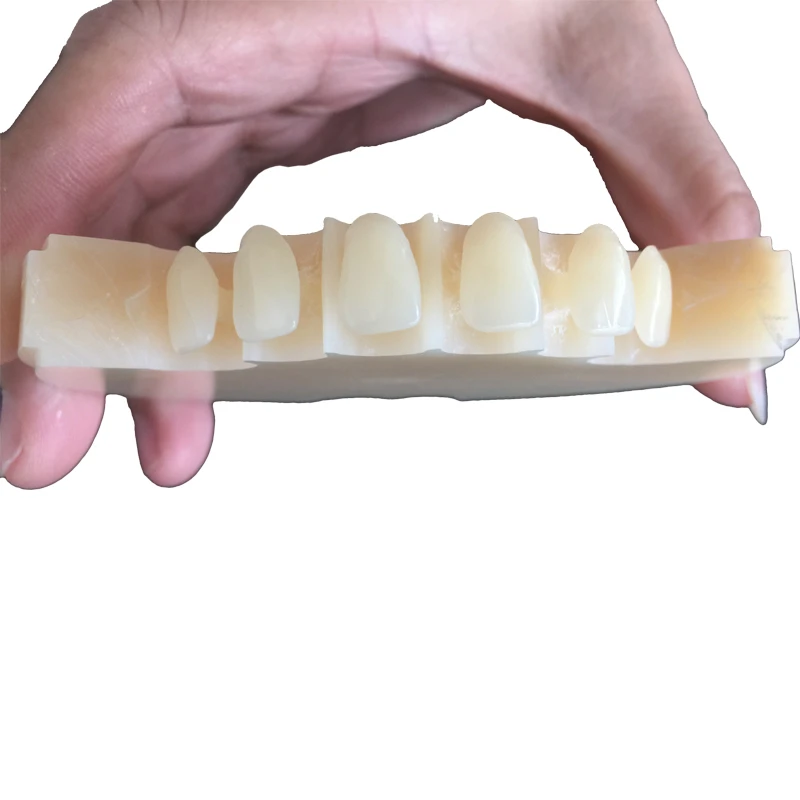
If you work with dental CAD/CAM materials, you have probably seen PMMA discs or blocks listed alongside zirconia, wax, and other milling materials. PMMA is one of those materials that looks simple from the outside. A disc is loaded into a milling machine, a temporary crown or bridge is milled, polished, and sent to the next stage of the workflow.
The material itself is more interesting than that.
PMMA has been used in dentistry for many years, but the material used in a modern dental laboratory is not necessarily the same as the acrylic resin mixed by hand in a traditional workflow. The polymer chemistry may be similar, while the manufacturing process, molecular structure, filler content, pigmentation, and mechanical properties can be quite different.
PMMA stands for polymethyl methacrylate. It is a thermoplastic polymer produced from methyl methacrylate (MMA). In dentistry, PMMA has been used for denture bases, provisional restorations, artificial teeth, orthodontic applications, and other laboratory-made components.
With CAD/CAM, PMMA is also supplied as industrially polymerized discs or blocks. The laboratory mills the material into the required shape instead of building the restoration from powder and liquid directly on the model.
For a laboratory or distributor buying PMMA, the word "PMMA" alone does not tell you enough about the material. Two discs can both be called PMMA but behave differently during milling, polishing, and clinical use.
That difference is worth understanding before comparing products only by price.
What exactly is PMMA?
PMMA is a polymer made by polymerizing methyl methacrylate monomers.
In simple terms, MMA is the small molecule used as the starting material, while PMMA is the much larger polymer formed after polymerization.
The basic chemical structure gives PMMA several useful characteristics:
relatively low density compared with ceramics and metals
good optical transparency in unpigmented form
relatively easy machining
good surface polishability
relatively stable dimensions compared with many hand-mixed acrylic systems
the ability to be modified with pigments and other additives
Pure PMMA is transparent. Dental PMMA is usually modified to obtain tooth-like shades, gingival shades, opacity, or other optical effects.
The final properties depend on much more than the name of the polymer. Polymer molecular weight, degree of conversion, residual monomer, fillers, pigments, and the manufacturing method can all affect the finished material.
This point matters when comparing a low-cost PMMA disc with a higher-priced CAD/CAM disc.
The material name may be identical, but the production history is not.
Why is PMMA used in dentistry?
The main reason is the balance between machinability, appearance, and mechanical performance.
PMMA is not a ceramic. It should not be judged using the same expectations as zirconia or lithium disilicate.
Instead, PMMA has a different role in the laboratory workflow.
A dental technician may choose PMMA when the restoration does not need the same material characteristics as a definitive high-strength ceramic restoration. Common applications include:
provisional crowns
provisional bridges
long-term provisional restorations in selected cases
diagnostic restorations
mock-ups
implant provisional restorations
denture-related components
artificial teeth
some occlusal or orthodontic applications
try-in restorations and workflow verification
The exact indication depends on the specific PMMA formulation.
For example, a simple temporary crown and a long-span implant-supported provisional bridge do not place the same demands on the material.
A laboratory may be comfortable using a basic PMMA for a single anterior temporary crown but choose a reinforced or higher-performance PMMA for a larger restoration.
That is one reason a buyer should not ask only:
"Is this PMMA?"
A better question is:
"Which PMMA is it, and what application was it tested for?"
Traditional acrylic resin and CAD/CAM PMMA are not the same thing
This is one of the common sources of confusion.
Traditional dental PMMA can be supplied as a powder-and-liquid system. The powder contains polymer particles, while the liquid contains MMA monomer and other components. After mixing, polymerization takes place.
CAD/CAM PMMA discs are manufactured before they reach the laboratory.
The manufacturer polymerizes the material under controlled industrial conditions and produces a solid disc or block. The dental laboratory then removes material mechanically with a milling machine.
This difference changes the working process considerably.
With a hand-mixed acrylic system, the final restoration can be affected by mixing, the powder-to-liquid ratio, polymerization conditions, air entrapment, and operator handling.
With an industrially polymerized disc, the laboratory starts with a material that has already gone through its main polymerization stage.
A 2020 literature review on CAD/CAM PMMA described CAD/CAM PMMA as an alternative material for provisional crowns, with advantages associated with CAD/CAM production such as accuracy and reduced processing time.
This does not mean every CAD/CAM PMMA disc is automatically better than every conventional acrylic resin.
It means that the two materials are produced differently and should be evaluated accordingly.
What happens inside a PMMA disc?
From a materials perspective, polymerization converts MMA molecules into long PMMA polymer chains.
The final disc may also contain pigments, cross-linking agents, fillers, or other modifiers depending on the formulation.
For a dental manufacturer, the polymerization stage is critical.
If the material is not sufficiently polymerized, residual monomer can remain in the material. Polymerization conditions also affect the internal structure and mechanical properties.
Industrial manufacturing gives the producer more control over temperature, pressure, polymerization time, and material consistency than a small laboratory mixing process normally can.
That consistency is one of the practical reasons CAD/CAM PMMA became common in digital dental laboratories.
However, "industrial polymerized" should not be treated as a performance number by itself.
A buyer still needs test data.
What are the main types of dental PMMA?
There is no single PMMA formulation that fits every dental application.
From a laboratory purchasing perspective, it is more useful to divide PMMA according to its intended use.
1. Standard PMMA for temporary restorations
This is the type many laboratories first encounter.
It is commonly used for provisional crowns and bridges where easy milling, finishing, and polishing are important.
The material usually offers sufficient mechanical performance for its intended temporary application while remaining relatively easy to machine.
The technician can mill the restoration, adjust the margins, polish the surface, and make minor corrections without the processing steps associated with ceramic materials.
2. High-strength or reinforced PMMA
Some PMMA materials contain reinforcing components or use a modified polymer structure to improve mechanical performance.
These materials may be used for longer-span provisional restorations, implant provisionals, or situations where the restoration is expected to remain in the mouth for a longer period.
The word "reinforced" should still be treated carefully.
Ask the manufacturer:
What is the reinforcement?
What is the flexural strength?
What is the flexural modulus?
How were the samples prepared?
Was the test performed before or after water storage?
What is the recommended indication?
A number without a test method is not very useful for technical comparison.
3. Multilayer PMMA
Some CAD/CAM PMMA discs use multiple shade layers.
The purpose is mainly aesthetic. Instead of producing the entire restoration from one uniform shade, the disc provides different shades or translucencies through its thickness.
For a laboratory, the important point is the relationship between the restoration position and the layers.
If the restoration is positioned incorrectly inside the disc, the final shade may not look as expected.
This matters when laboratories process several PMMA brands on the same milling machine. The technician needs to know whether the disc has a defined insertion direction or layer transition.
4. Gingiva-colored PMMA
Pink PMMA is used for gingival-colored components and some implant- or denture-related applications.
The technical requirements are different from those of a white or tooth-colored temporary crown.
Color consistency between batches becomes noticeable when a laboratory produces multiple units for the same case.
For distributors, this is an area where asking for batch-to-batch shade information can be more useful than simply asking whether the material has "good color."
PMMA versus PMMA-based dental resin
Another distinction worth making is between milled PMMA and 3D-printed dental resin.
They are not interchangeable just because both may contain methacrylate chemistry.
A CAD/CAM PMMA disc is a pre-polymerized solid material that is mechanically milled.
A 3D-printing resin is a liquid photopolymer system that is polymerized layer by layer during printing and then normally requires washing and post-curing.
A review comparing 3D-printed provisional materials with conventional and CAD/CAM-milled provisional materials found that the properties of these groups can differ in areas such as flexural strength, fracture behavior, surface roughness, and water absorption.
So a laboratory evaluating a new "PMMA resin" should first clarify whether the product is:
a milling disc, a powder-liquid acrylic system, or a printable resin.
They belong to related polymer families, but the processing route is different.
How strong is dental PMMA?
This is probably the first technical question from a laboratory buyer.
There is no single flexural strength value for "PMMA."
The result depends on the material formulation and test method.
ISO 10477:2020, which covers polymer-based crown and veneering materials, specifies a minimum flexural strength of 50 MPa for the applicable materials. The same standard also includes requirements concerning water sorption, solubility, and bond strength.
Research on CAD/CAM PMMA commonly reports values above this minimum, and a recent review describes milled PMMA crown materials with flexural strengths around 80–100 MPa, while conventional provisional materials are often reported around 50–70 MPa. These numbers are useful as a general reference, but they should not be treated as universal specifications for every commercial PMMA.
For example, suppose a supplier gives you these two numbers:
Material A: 75 MPa
Material B: 105 MPa
It is tempting to conclude that Material B is automatically better.
That conclusion is too quick.
You should ask whether both values were measured using the same standard, specimen geometry, conditioning period, and testing procedure.
If Material A was tested after water storage and Material B was tested dry, the numbers are not directly comparable.
This is a common problem in material comparisons.
Flexural strength is not the whole story
A PMMA restoration does not fail only because the material reaches a particular flexural-strength value.
The restoration geometry matters.
Consider a provisional bridge with a thin connector.
Even if the PMMA disc has good laboratory test results, a poorly designed connector creates a local stress concentration.
The same material can behave very differently in:
a single crown
a three-unit bridge
a long-span bridge
an implant-supported provisional
a full-arch provisional restoration
The milling strategy matters as well.
Sharp internal corners, insufficient thickness, and aggressive occlusal adjustment can reduce the effective strength of the final restoration.
For this reason, when a laboratory asks about the strength of a PMMA disc, I would not stop at the material data sheet.
I would also ask:
What restoration are you making?
That question often tells you more about whether the material is suitable.
What about water absorption?
PMMA is a polymer, and polymers interact with water.
Water can enter the material over time. The effect is not simply a matter of the restoration becoming "wet." Water can influence the movement of polymer chains and change mechanical behavior.
A recent review reported that PMMA specimens exposed to artificial saliva showed reductions in flexural strength of roughly 20–30% after 3–6 months in the studies it reviewed. The exact result varies with formulation and test conditions.
This is useful information for laboratories because a dry laboratory test does not reproduce every condition inside the mouth.
ISO 10477:2020 sets a water-sorption limit of 40 µg/mm³ for the applicable polymer-based crown and veneering materials, along with a solubility limit of 7.5 µg/mm³.
These numbers give a laboratory a standardized reference point.
They do not mean that every PMMA application has the same clinical lifetime.
Why does PMMA polish so well?
One of the practical advantages of PMMA is its surface finish.
After milling, the surface can be adjusted using appropriate burs, rubber polishers, and polishing compounds.
Compared with many ceramic materials, PMMA is relatively easy to modify.
This is useful when the technician needs to make small changes to:
occlusion
proximal contact
emergence profile
margin area
surface texture
tooth contour
The polishing procedure still matters.
A rough milled surface can retain plaque more easily than a properly finished surface. The final result depends on milling parameters, tool condition, and polishing technique rather than the material name alone.
A laboratory comparing two PMMA discs should therefore test not only fracture strength but also:
How much finishing time does one disc require?
For a laboratory producing 20 or 30 provisional restorations per day, this can have a direct effect on production cost.
A simple laboratory example
Imagine a laboratory mills 20 provisional crowns every working day.
With PMMA A, the average finishing and polishing time is 5 minutes per crown.
With PMMA B, the average time is 8 minutes.
The difference is only 3 minutes per crown.
For one crown, it is almost irrelevant.
For 20 crowns:
20 × 3 minutes = 60 minutes per day.
Over 22 working days:
60 × 22 = 1,320 minutes
That is 22 hours per month.
For this kind of comparison, I would not evaluate a PMMA disc only by its purchase price.
If one material costs slightly more per disc but reduces finishing time, tool wear, or remakes, its actual laboratory cost may be lower.
The numbers above are an example rather than a universal production benchmark, but this is the type of calculation a laboratory can make using its own production data.
What should a dental laboratory check before buying PMMA?
For laboratories testing a new PMMA disc, I would recommend looking at at least these points.
1. Intended indication
Do not start with the price.
Start with the intended application.
Ask whether the material is recommended for:
single temporary crowns
bridges
long-term provisionals
implant provisionals
full-arch temporary restorations
diagnostic work
denture applications
A material suitable for a single crown may not be the best choice for a large full-arch restoration.
2. Flexural strength
Ask for the actual test value and test standard.
A statement such as "high-strength PMMA" is not enough for technical evaluation.
Ask for the MPa value and test conditions.
3. Flexural modulus
Strength and stiffness are different.
A material can have reasonable flexural strength while behaving differently under repeated loading because of its modulus.
For larger provisional structures, this parameter can be useful when comparing materials.
4. Water sorption and solubility
These values provide additional information about how the polymer behaves in a wet environment.
ISO 10477 provides standardized limits for applicable polymer-based crown and veneering materials.
5. Residual monomer
For polymeric dental materials, residual monomer is a useful quality-control parameter.
The lower the amount of unreacted monomer, the less monomer remains in the polymerization system after processing.
The exact acceptable level depends on the product category and applicable regulatory requirements.
A serious manufacturer should be able to explain how polymerization and residual monomer are controlled.
6. Disc dimensions
For CAD/CAM laboratories, dimensions are practical rather than cosmetic.
Check:
disc diameter
thickness options
compatible holder
open or closed CAD/CAM system
usable milling area
compatibility with the laboratory's existing machines
A disc that cannot be securely mounted is not useful, regardless of its material data.
7. Shade consistency
For tooth-colored PMMA, ask for information about shade consistency between batches.
If a laboratory purchases the same shade several times, a visible difference between batches creates problems.
This is especially noticeable in multi-unit provisional restorations.
8. Milling behavior
This is difficult to understand from a datasheet alone.
A laboratory should actually mill the material.
During a trial, record:
milling time
edge chipping
margin quality
bur wear
dust characteristics
surface roughness
polishing time
fracture during adjustment
A 2-hour material test can reveal problems that a technical brochure will not show.
Why can two PMMA discs have different milling behavior?
Several factors can contribute.
The polymer structure is one factor.
Fillers and modifiers are another.
Disc hardness also affects the interaction between the material and milling burs.
The machine settings matter as well.
A disc that performs well with one CAM strategy may behave differently when another laboratory uses a different feed rate, spindle speed, or tool condition.
For example, if a technician reports excessive chipping, it does not automatically mean the PMMA itself is poor.
The problem may come from a worn bur, an inappropriate milling strategy, insufficient cooling, or an unsuitable tool path.
For that reason, material testing should ideally be carried out using the laboratory's actual machine and normal milling tools.
PMMA is easy to mill, but that does not mean every PMMA is the same
From a manufacturer's perspective, this is one of the useful distinctions.
The word "PMMA" describes the polymer family.
It does not describe the entire formulation.
Think about two bottles of wine made from the same grape variety. The grape name tells you something, but not everything about the final product.
PMMA works in a similar way.
The polymer is only the starting point.
The manufacturing process determines much of what the laboratory finally receives.
For a dental manufacturer, controlling polymerization, pigment distribution, disc density, internal defects, and dimensional consistency is part of producing a consistent CAD/CAM material.
For a buyer, the practical question is whether those controls are reflected in repeatable test results and consistent milling performance.
Can PMMA be used as a final permanent restoration?
This question needs a careful answer.
It depends on the exact material and its regulatory indication.
Not every PMMA disc is intended for permanent intraoral use.
Some are manufactured specifically for temporary or provisional restorations. Others may have different indications based on their composition and regulatory clearance.
A laboratory should not assume that a material can be used permanently just because its flexural strength looks high.
The product's instructions for use, regulatory status, and intended indication should be checked.
A manufacturer should be able to provide this information clearly.
PMMA has another practical advantage: it is easy to modify
One practical reason technicians continue to use PMMA is that it is relatively forgiving during adjustment.
Suppose a provisional crown has a slightly high occlusal contact.
The technician can make a small adjustment with a suitable bur and polish the area again.
If the contour needs modification, material can be removed relatively quickly.
For provisional restorations, this is useful because the restoration often acts as part of the clinical treatment process rather than simply being the final product.
The dentist may use it to evaluate:
tooth shape
occlusion
vertical dimension
phonetics
gingival response
patient acceptance of the appearance
In these situations, the ability to adjust the material has practical value.
What should distributors ask a PMMA manufacturer?
For distributors, the evaluation process is slightly different.
A distributor does not only need a good-looking disc.
The product needs consistent specifications that can be explained to customers.
Before adding a PMMA product to a portfolio, I would ask the manufacturer for:
Technical data sheet
Intended indication
Material composition or material description
Flexural strength
Flexural modulus, if available
Water sorption
Solubility
Shade information
Available disc dimensions
Recommended milling parameters
Shelf life
Storage conditions
Regulatory documents
Batch traceability
Quality-control information
For a distributor, batch traceability is especially useful.
If a laboratory reports a problem six months after purchasing a material, the manufacturer needs to identify which batch was supplied and investigate the production records.
A professional material supply chain is not just about putting discs into cartons.
The manufacturer needs to know what was produced, when it was produced, and which quality checks were performed.
A practical way to compare three PMMA products
Suppose a laboratory is considering three products.
| Property | PMMA A | PMMA B | PMMA C |
|---|---|---|---|
| Flexural strength | 80 MPa | 105 MPa | 95 MPa |
| Flexural modulus | 2,200 MPa | 2,600 MPa | 2,400 MPa |
| Water sorption | Not provided | 32 µg/mm³ | 28 µg/mm³ |
| Milling time | 18 min | 20 min | 17 min |
| Polishing time | 7 min | 5 min | 6 min |
| Price/disc | $X | $X + 15% | $X + 8% |
Looking only at flexural strength, PMMA B appears to be the strongest.
But the laboratory may find that PMMA C has the shortest total processing time.
If PMMA B takes longer to mill but requires less polishing, the actual labor cost may still be competitive.
The correct choice depends on the laboratory's production priorities.
I prefer to look at total workflow cost instead of material price alone.
What is the biggest misunderstanding about PMMA?
The biggest misunderstanding is probably that PMMA is simply a cheap temporary material.
That description is too narrow.
PMMA has been used in dentistry for decades, and modern CAD/CAM manufacturing has changed how the material is processed.
The important difference is not simply "PMMA versus another material."
It is the relationship between:
polymer formulation + manufacturing process + restoration design + milling process + clinical indication.
A well-made PMMA disc can be very useful in the right application.
A high-strength PMMA can still be unsuitable if it is used outside its intended indication.
Likewise, a relatively inexpensive standard PMMA may be a practical choice for a laboratory producing a large number of short-term provisional restorations.
Final thoughts from a material-development perspective
When I discuss PMMA with dental laboratories, I usually recommend starting with the application rather than the material name.
PMMA is a polymer family, not one fixed specification.
A dental laboratory should know what type of PMMA it is buying, what the disc is intended for, how it performs under standardized testing, and how it behaves on the laboratory's own milling system.
For a manufacturer, the work does not end when the PMMA disc reaches the required dimensions.
Polymerization quality, internal consistency, shade stability, dimensional control, and batch-to-batch repeatability all matter.
For a laboratory, the most useful test is often a combination of laboratory data and a real milling trial.
For example, if a new disc has a reported flexural strength of 100 MPa, that tells you something about the material. If the same disc also gives clean margins, low chipping, reasonable bur wear, and predictable polishing time in your own workflow, you have much more useful information.
For distributors, the same principle applies.
A good PMMA product should come with technical information that can be explained to the laboratory without relying on vague phrases such as "premium quality" or "high performance."
The more specific the information is, the easier it becomes for a laboratory to decide whether the material fits its workflow.
PMMA is not the material for every dental restoration.
It does not need to be.
Its value comes from having a useful combination of polymer properties, machinability, appearance, and processing convenience in applications where those characteristics make sense.
That is probably the most practical way to understand PMMA in modern dentistry: not as a replacement for every other dental material, but as a polymer with a defined role in the laboratory workflow.