





Why Does a Dental Milling Machine Need a Vacuum Cleaner?
 Oct 20, 2026|

Why Does a Dental Milling Machine Need a Vacuum Cleaner?
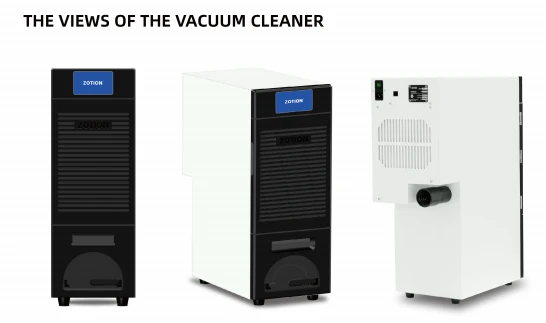
A dental milling machine can complete a zirconia crown, bridge framework, or PMMA restoration without any obvious problem, yet the condition of the surrounding workspace may tell a different story. Fine powder can accumulate around the machine, dust may remain inside the working chamber, and technicians may spend additional time cleaning the equipment between jobs.
These are common reasons to consider dust extraction when investing in CAD/CAM equipment.
A dental vacuum cleaner is more than an accessory added to a milling machine. It helps collect machining waste, control the spread of dust, and keep daily laboratory work manageable.
The need for dust collection becomes more apparent as production volume increases. A small amount of dust from one job may seem insignificant, but repeated across dozens of jobs, the accumulated waste can become substantial.
From a dental equipment manufacturer's perspective, evaluating a vacuum cleaner involves more than checking whether it produces suction. The main questions are whether the extraction system matches the milling machine, whether dust is captured effectively during machining, and whether the setup is practical under the laboratory's actual working conditions.
This article explains why dental milling machines need suitable dust extraction, what can happen when it is inadequate, and what laboratory owners and distributors should consider before selecting a system.
1. Dental Milling Produces Waste Even When the Finished Restoration Looks Clean
CAD/CAM milling is a subtractive manufacturing process. The milling machine starts with a blank and removes material until the restoration reaches its programmed shape.
For example, a zirconia disc may contain enough material for several crowns or a multi-unit bridge. Only part of the original blank becomes the finished restoration. The remaining material stays in the disc as unused material, breaks away as larger fragments, or is removed as smaller particles during cutting.
Not all milling waste behaves in the same way.
Larger fragments may settle quickly inside the working chamber. Finer particles can remain suspended in moving air, settle on surrounding surfaces, or accumulate in areas that are difficult to reach during routine cleaning.
The material being milled also affects the nature of the waste. Zirconia is a ceramic material, while PMMA is a polymer. Wax and other dental materials have their own machining characteristics. Their waste should not automatically be treated as interchangeable simply because it comes from a milling machine.
Consider a laboratory producing 20 zirconia crowns in a working day. Depending on the nesting arrangement, restoration size, and material utilization, the laboratory may use several blanks. Even if each job generates only a modest amount of loose debris, the cumulative waste can become noticeable over time.
This is an illustrative production scenario, not a measured dust-generation rate. The actual amount depends on blank size, restoration geometry, nesting strategy, and milling parameters.
Dust generation is a normal part of the manufacturing process. It does not, by itself, indicate that a milling machine is malfunctioning. The question is how the laboratory manages the waste.
2. Dust Extraction Helps Control Occupational Exposure
One of the main reasons to use a suitable dental vacuum cleaner is to control the spread of dust generated during machining.
Dental technicians may work close to milling machines for extended periods. They open machine doors, remove completed jobs, clean fixtures, handle used blanks, and perform finishing operations. If dust escapes from the intended collection area, technicians may encounter it during these routine tasks.
Particle size and composition influence potential exposure. Fine particles can behave differently from larger fragments, and their visibility is not a reliable indication of whether they can be inhaled.
Zirconia milling waste should not be described as identical to crystalline silica dust, nor should every material be assigned the same hazard profile. Risk depends on the material's composition, the form of the dust, the process involved, and the level of exposure.
Fine particulate control remains an important workplace consideration.
The US Centers for Disease Control and Prevention, through NIOSH, has published investigations into airborne contaminants in dental workplaces and the use of local exhaust ventilation during dust-generating procedures. In its 2024 evaluation of a dental clinic, investigators found higher air contaminant levels when local exhaust ventilation controls were not consistently used. That investigation concerned dental clinic procedures rather than providing a direct measurement of zirconia milling dust. It is therefore related evidence about workplace dust control, not a performance study of dental milling vacuum cleaners.
Reference: CDC/NIOSH, Evaluation of Exposures and Health Concerns in a Dental Clinic.
For a dental laboratory, the practical approach is to capture dust as close as possible to the point where it is generated. Once particles have spread across the room, controlling them becomes more difficult.
A suitable extraction arrangement is one part of workplace dust management. It does not automatically eliminate exposure. Appropriate enclosure design, ventilation, cleaning procedures, and any personal protective equipment required by the risk assessment and local regulations may also be necessary.
3. Dust Can Enter Areas That Are Not Intended to Collect It
A milling machine contains more than a spindle and cutting tools. Depending on the model, it may also contain motion components, sensors, electrical connections, pneumatic elements, and other assemblies.
These components operate under different conditions and have different maintenance requirements. Dust accumulation in areas not intended to collect machining waste can make inspection and cleaning more difficult.
The risk should not be overstated. Not every particle that enters a machine causes damage, and a vacuum cleaner cannot guarantee that every internal area will remain completely dust-free. The design of the milling chamber, seals, airflow, and internal protection also affects dust control.
Dust management is nevertheless relevant to machine maintenance.
Consider a laboratory that notices powder collecting around a chamber opening after several days of production. The technician cleans the visible surface, but dust continues to accumulate in the same location. Rather than treating this solely as a cleaning issue, the operator should check whether the extraction arrangement is functioning as intended, whether the collection opening is unobstructed, and whether the machine enclosure is being used correctly.
The appropriate response depends on the machine's design and instructions. Operators should not remove covers or attempt internal cleaning in ways that the manufacturer does not permit.
For distributors advising customers, it is useful to explain that the vacuum cleaner is only one part of the dust-control arrangement. The milling machine's enclosure and maintenance procedures also matter.
4. Dust Collection Can Reduce the Time Spent on Routine Cleaning
Cleaning is part of running a dental laboratory, but unnecessary dust accumulation can make the task more time-consuming.
Technicians may need to wipe workbenches, clean the exterior of the milling machine, remove powder around the chamber opening, and check nearby surfaces. The amount of work varies according to the equipment, material, extraction arrangement, and frequency of use.
A simple calculation can help a laboratory estimate the possible effect on labor time.
Suppose a laboratory operates five days a week and spends an additional 10 minutes per working day cleaning dust that could otherwise be better controlled.
The calculation is:
10 minutes × 5 days = 50 minutes per week.
50 minutes × 52 weeks = 2,600 minutes per year.
2,600 minutes ÷ 60 = approximately 43.3 hours per year.
At an assumed fully loaded labor cost of US$20 per hour, those 43.3 hours represent approximately US$866 in annual labor time.
These figures are illustrative, not a claim that installing a vacuum cleaner will save exactly US$866. The assumed 10-minute daily difference must be verified in the laboratory. The calculation also excludes the cost of the vacuum cleaner, electricity, filters, maintenance, and any other changes to the workflow.
The value of this exercise is that it gives a laboratory owner a way to evaluate cleaning time rather than relying on a general claim that dust extraction improves efficiency.
A practical trial can be conducted over two comparable working periods. The laboratory can record cleaning time, the number of milling jobs, the materials processed, and the condition of the work area at the end of each shift. The results will be more useful if the workload and cleaning procedure remain reasonably consistent.
5. The Vacuum Cleaner Must Match the Milling Machine
A vacuum cleaner that works well with one milling machine may not be suitable for another.
Different machines have different extraction requirements. These may be specified in terms of airflow, static pressure, hose dimensions, electrical requirements, or compatibility with an automatic control system.
One example comes from the manufacturer documentation for the DGSHAPE DWX-52Di. Its published guidance specifies a dust collector with static pressure of at least 4 kPa and airflow of at least 2 m³/min.
These figures can also be expressed as:
Static pressure: 4 kPa = 4,000 Pa.
Airflow: 2 m³/min = 120 m³/h.
The conversion simply changes the units; it does not change the equipment requirement.
Reference: DGSHAPE DWX-52Di specifications and FAQ.
The point is not that every dental milling machine requires 4 kPa and 2 m³/min. The example shows how specific requirements for an individual machine can give buyers a basis for checking compatibility.
Buyers should also understand the difference between a maximum airflow figure in a vacuum cleaner brochure and the airflow available after the machine is connected to a hose, fittings, and filter assembly. The figures may represent different test conditions.
Before placing an order, the laboratory should confirm the requirements for its exact milling machine model and compare them with the vacuum cleaner manufacturer's technical documentation.
This check is particularly useful for distributors selling equipment from several brands. A general statement such as "compatible with all dental milling machines" is not a substitute for verifying compatibility with each model.
6. Dust Collection Matters More as Production Volume Increases
The need for dust collection is not determined by laboratory size alone. The number of machines, working hours, materials processed, and cleaning arrangements all influence the amount of dust generated and the demands placed on the collection system.
A small laboratory operating one milling machine for a limited number of jobs each day may have different requirements from a production centre running several machines across multiple shifts.
Consider two hypothetical laboratories.
Laboratory A operates one desktop milling machine and completes approximately five jobs per day. The technician checks the machine after each job and performs a regular end-of-day cleaning routine.
Laboratory B operates three milling machines and completes approximately 25 jobs per day. Several jobs may run in succession, leaving less time for cleaning between cycles.
Laboratory B is likely to generate more cumulative machining waste because it processes more jobs. However, job count alone cannot establish the required vacuum cleaner capacity. A job involving a large bridge may remove a different amount of material from a small restoration, and the milling strategy also affects the amount of waste produced.
The extraction system should be assessed against the actual workload, including whether the vacuum cleaner will serve one machine or multiple machines.
The laboratory should also consider whether extraction remains effective during its busiest periods. A unit that is adequate for occasional operation may not be suitable for a substantially longer daily duty cycle.
For distributors, asking about the customer's current production and planned expansion is often more useful than recommending a model based only on the number of employees.
7. A Vacuum Cleaner Helps Keep Material Waste Under Control
Dental milling materials can be expensive, but dust collection should not be presented as a method of recovering all the material removed from a blank.
The primary purpose of the vacuum cleaner is to collect waste and control dust. Once particles have been mixed with other debris or captured in a filter, their recovery and reuse may not be practical or permitted.
Collecting the waste in a defined location makes it easier to handle and dispose of according to the material manufacturer's instructions and local requirements.
This consideration becomes relevant when laboratories process several types of material. Waste streams should not automatically be mixed if material specifications or disposal rules require separate handling.
For example, a laboratory may process zirconia during one job and PMMA during another. The operator should follow the manufacturers' recommendations for collecting and disposing of the resulting waste rather than assuming that all collected material can be handled in the same way.
Distributors can assist by providing clear information about intended materials, compatible collection accessories, and maintenance procedures.
Material utilization should also be distinguished from dust collection. The amount of zirconia left in a blank depends on nesting, restoration geometry, blank dimensions, and the milling strategy. A vacuum cleaner does not directly improve these factors.
Its contribution is to manage the loose waste generated during machining, not to reduce the amount of material required to manufacture a restoration.
8. A Cleaner Work Area Makes Inspection and Maintenance More Practical
A milling machine should be inspected and maintained according to its manufacturer's instructions. Dust accumulation can make some visual checks more difficult, particularly around areas where machining debris tends to collect.
When the work area is reasonably clean, technicians can more easily identify changes such as loose connections, damaged hoses, unusual deposits, or debris around the chamber opening.
This does not mean that a vacuum cleaner prevents mechanical wear or guarantees machining accuracy. Milling accuracy depends on many factors, including the machine's mechanical condition, calibration, tool condition, material properties, and machining strategy.
Dust collection is one supporting measure within a wider maintenance routine.
For example, if a technician notices that powder repeatedly collects near a hose connection, the observation can be recorded and investigated. The cause may involve the connection, the extraction arrangement, or the way the machine is being operated. The technician should follow the appropriate inspection procedure rather than assuming that the milling machine itself has developed a mechanical fault.
For laboratory owners, a useful maintenance record can include the inspection date, the condition of the hose and connections, the state of the collection container, and any unusual dust accumulation.
For distributors, practical maintenance guidance is also part of customer service. Customers often need to know what they can inspect themselves, which consumables are available, and when a problem requires assistance from the equipment supplier.
9. What Happens If a Laboratory Uses an Unsuitable Vacuum Cleaner?
A vacuum cleaner may be present in the laboratory without providing adequate dust control.
There are several possible reasons.
The unit may not meet the milling machine's specified extraction requirements. The hose may be too long or incorrectly routed. An adapter may not fit properly. The filter may be unsuitable for the application, or the collection system may not be configured according to the manufacturer's instructions.
In some cases, the vacuum cleaner may operate normally but still fail to provide the intended result at the point where dust is generated.
A running motor and an audible suction sound are not enough to establish that the system is working effectively.
Consider a laboratory that purchases a vacuum cleaner based only on its electrical power rating. After installation, the technician finds that dust still accumulates inside the milling chamber. The next step is to compare the installed system with the milling machine manufacturer's requirements, check the connections and installation, and confirm the operating conditions.
Depending on the findings, the solution may involve correcting the installation or selecting a different unit.
The cause cannot be identified from the symptom alone. A laboratory should not assume that a larger motor will automatically solve the problem.
The same principle applies to filtration. A product description that mentions a fine filter does not establish that the complete unit meets every workplace requirement. Buyers should ask for the relevant filter classification, supporting test information, and instructions for the intended application.
10. What Should Dental Laboratories and Distributors Check Before Purchasing?
A purchase decision should begin with the intended use, not with a product photograph or a single specification.
The following points provide a practical starting checklist.
1. Confirm the exact milling machine model.
Check the manufacturer's requirements for static pressure, airflow, hose connection, and any required accessories.
2. Identify the materials being processed.
Confirm that the collection system is suitable for the intended materials and operating conditions.
3. Review the filtration documentation.
Ask for the filter type, relevant classification or test information, and instructions for correct installation.
4. Check the expected working hours.
Consider the laboratory's daily workload and whether the vacuum cleaner is intended for occasional use or extended production.
5. Confirm the control interface.
If automatic start and stop are required, verify that the exact milling machine and vacuum cleaner can communicate correctly.
6. Understand maintenance requirements.
Ask how collected waste is removed, which filters or consumables require replacement, and how replacement parts can be obtained.
7. Check the electrical and installation requirements.
Voltage, frequency, available space, exhaust arrangements, and other installation conditions should be confirmed before delivery.
8. Ask about technical support.
For distributors, clear installation instructions and access to replacement parts can be important when supporting customers in different countries.
These checks can also prevent avoidable misunderstandings after delivery. A vacuum cleaner should be evaluated as part of the complete milling setup, rather than as an independent product whose specifications can be compared without context.
Conclusion
A dental milling machine needs suitable dust extraction because milling generates waste that must be managed throughout the production process. A properly selected vacuum cleaner can help control the spread of machining dust, reduce the burden of routine cleaning, and support a more manageable laboratory environment.
Its contribution should not be exaggerated. It does not eliminate every airborne particle, guarantee machine accuracy, or replace maintenance and workplace safety procedures. Its effectiveness depends on the equipment, installation, materials, and way the system is used.
For dental laboratories, the starting point is to identify the actual milling requirements and establish a suitable dust-control arrangement. For distributors, the priority is to confirm compatibility and provide customers with accurate technical information.
The DWX-52Di example illustrates why checking the manufacturer's specifications matters: its stated extraction requirements provide specific values that can be reviewed before purchase. Other milling machines may have different requirements, so these figures should not be treated as a universal standard.
From a manufacturer's perspective, the most suitable dental vacuum cleaner is not necessarily the model with the highest advertised power. It is the model whose documented capabilities match the milling machine, materials, working hours, and maintenance arrangements of the laboratory using it.