





What Is the Difference Between 3Y, 4Y, and 5Y Dental Zirconia?
 Oct 20, 2026|

What Is the Difference Between 3Y, 4Y, and 5Y Dental Zirconia?
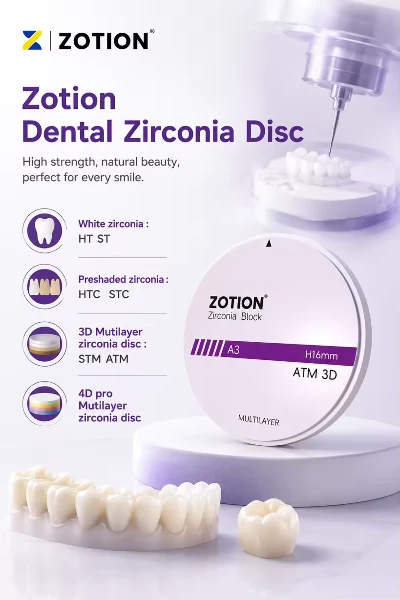
When comparing dental zirconia blanks, laboratories often start with three numbers: 3Y, 4Y, and 5Y. These labels appear in product catalogs, technical data sheets, and discussions about strength and translucency. A common assumption is that 3Y is the strongest, 5Y is the most translucent, and 4Y falls somewhere between them.
That is a useful starting point, but it does not tell the whole story.
The numbers refer to the nominal molar percentage of yttria, or yttrium oxide (Y₂O₃), used to stabilize zirconia. Changes in yttria content affect the crystal phases present in the material. These phases influence how the ceramic interacts with light and responds to mechanical stress.
For a dental laboratory, the distinction matters when selecting a blank for a particular restoration. A material with attractive translucency may not be the most suitable option for every load-bearing application. Likewise, a material with a high flexural strength value may require more consideration of shade, thickness, and the desired appearance.
For distributors, understanding these differences makes it easier to explain product specifications accurately and compare materials from different manufacturers without relying on marketing labels alone.
This article explains the main differences between 3Y, 4Y, and 5Y dental zirconia, what published strength data can tell us, and which questions laboratories should ask before choosing a material.
1. What Do 3Y, 4Y, and 5Y Actually Mean?
The letter Y refers to yttria, the common name for yttrium oxide. In the labels 3Y, 4Y, and 5Y, the numbers generally refer to the nominal molar percentages of yttria in the zirconia composition.
These classifications are based on composition, not on a direct measurement of strength or translucency.
| Material classification | Nominal yttria content | General material characteristic |
|---|---|---|
| 3Y zirconia | Around 3 mol% | Greater contribution from the tetragonal phase and strong transformation-toughening potential |
| 4Y zirconia | Around 4 mol% | Intermediate composition, balancing optical and mechanical properties |
| 5Y zirconia | Around 5 mol% | Greater cubic-phase content in many formulations, generally improving translucency while reducing transformation toughening |
These descriptions reflect broad material trends. They should not be treated as guaranteed specifications for every commercial blank.
The distinction between mol% and wt% is also worth understanding. Mol% describes the proportion of a substance based on the number of moles, whereas wt% describes its proportion by mass. The two measurements are not interchangeable. If a supplier reports yttria content without specifying the basis, the buyer should request clarification before comparing technical data.
Yttria content is only one part of the formulation. Alumina content, other additives, powder characteristics, manufacturing conditions, and the resulting microstructure can all affect the properties of the finished ceramic.
As a result, two products carrying the same 4Y label may differ in translucency, flexural strength, and fracture behavior.
2. Why Does Yttria Content Change the Properties of Zirconia?
Understanding the differences between these materials starts with their crystal structures.
Zirconia can exist in different crystal phases, including monoclinic, tetragonal, and cubic phases. Pure zirconia changes phase with temperature, and yttria is added to stabilize structures that would otherwise be less stable under particular conditions.
In conventional 3Y zirconia, the tetragonal phase plays an important role in its mechanical behavior. When a crack begins to develop, some tetragonal grains can transform into the monoclinic phase near the crack tip. This transformation involves a volume change that can help resist crack propagation. The mechanism is commonly known as transformation toughening.
Its effectiveness depends on the material's composition and microstructure. It does not mean that a zirconia restoration cannot crack.
As yttria content increases, the phase balance changes. Many 4Y and 5Y formulations contain a greater proportion of cubic or cubic-like phases than conventional 3Y materials. These phases affect optical behavior because their crystal structures interact with light differently from tetragonal zirconia.
Higher yttria content generally improves translucency, but it can also reduce the contribution of transformation toughening. The result is a trade-off between optical appearance and certain mechanical properties.
A review published in Dental Materials in 2021 examined 53 studies on the strength and translucency of aesthetic monolithic zirconia. It identified material composition, microstructure, and surface treatment as important influences on measured properties. The authors also discussed the mechanical compromises associated with increasing translucency.
The practical point is that adding more yttria does not simply make zirconia better or worse. It changes the balance of properties, and the most suitable balance depends on the restoration and its intended use.
3. How Do 3Y, 4Y, and 5Y Differ in Flexural Strength?
Flexural strength is one of the most frequently quoted values on a zirconia product data sheet. It describes the stress at which a specimen fractures during a specified bending test.
The value is useful, but it does not provide a complete picture of a restoration's performance. A test specimen and a finished crown differ in geometry, surface condition, and stress distribution.
Published research can help illustrate the broad differences between material generations.
A systematic review published in the Journal of Prosthodontic Research in 2026 examined 78 laboratory studies of commercially available translucent zirconia. It reported the following average flexural strength values:
| Material group | Mean flexural strength reported in the review |
|---|---|
| 4Y-PSZ | 803 ± 233 MPa |
| 5Y-PSZ | 570 ± 116 MPa |
The review found a statistically significant difference between these group averages. However, the standard deviations also show considerable variation in the results, particularly for 4Y materials. The researchers identified specimen preparation, surface treatment, and test method as important factors affecting reported strength values.
These figures are research findings, not guaranteed values for every 4Y or 5Y blank.
They also cannot be used to calculate the exact fracture load of a crown. A restoration's performance depends on more than the average flexural strength of the material from which it was milled.
Why can two products have different strength values?
Suppose a distributor compares two technical data sheets:
Product A lists a flexural strength of 1,000 MPa.
Product B lists a flexural strength of 750 MPa.
At first glance, Product A appears to offer better mechanical performance. Before drawing that conclusion, however, the distributor should check how the figures were obtained.
Were both products tested using the same method? Were the specimens prepared and finished in the same way? Were the values measured before or after surface treatment? Does the report describe an average, a minimum specification, or a selected result?
If one supplier reports the mean value from a group of specimens and another lists a minimum acceptance value, the figures do not have the same meaning.
A reliable comparison starts with the test method and product-specific documentation, rather than simply selecting the largest number in the catalog.
4. Why Is 3Y Zirconia Often Associated With Higher Mechanical Performance?
Conventional 3Y zirconia has a relatively high proportion of tetragonal zirconia compared with many higher-yttria formulations. This gives it greater potential for transformation toughening and generally supports higher strength and fracture resistance.
These characteristics can be useful when the restoration's design and intended application place greater demands on mechanical performance.
However, the 3Y label does not mean that every restoration made from 3Y zirconia will outperform one made from 4Y or 5Y. The outcome also depends on the actual product formulation, milling damage, surface condition, restoration geometry, and processing history.
For example, a laboratory might choose a 3Y blank because its data sheet reports high flexural strength. If the finished restoration contains damage introduced during adjustment, the original material specification alone cannot predict how the restoration will perform.
This distinction matters to laboratories purchasing blanks in volume. Published strength values should be considered alongside specification consistency, processing instructions, and the laboratory's experience with the material.
Optical appearance also needs attention. Some 3Y formulations are less translucent than many 4Y and 5Y products, although the difference varies among manufacturers and product generations. A laboratory choosing 3Y for its mechanical properties may need to consider the required shade, restoration thickness, and overall aesthetic target.
The decision is not simply whether 3Y is strong. It is whether its combination of mechanical and optical properties suits the particular case.
5. Why Is 5Y Zirconia Generally More Translucent?
One of the main reasons for increasing yttria content in dental zirconia was to improve its optical appearance.
In many 5Y formulations, the increased proportion of cubic or cubic-like phases reduces some of the light scattering associated with the microstructure of conventional zirconia. This can improve light transmission and give the material a more natural-looking appearance under suitable conditions.
However, not all 5Y zirconia has the same translucency.
A systematic review and meta-analysis published in BMC Oral Health in 2024 examined 53 studies of zirconia optical properties. It found that yttria content had a significant effect on translucency, while also identifying other influences, including material thickness, microstructure, additives, phase distribution, and sintering conditions. The authors reported substantial variation among materials within the same general generation.
For product selection, the 5Y label provides useful information about the material category, but it does not replace an actual translucency specification.
Why does thickness matter?
Light must pass through the material before reaching the observer. Changes in the optical path can affect the amount of light transmitted and scattered.
A 5Y specimen measured at 0.5 mm cannot be compared directly with a 3Y specimen measured at 1.5 mm without accounting for the difference in thickness. The background used during testing and the measurement method can also influence the result.
The same issue arises when evaluating shade samples. Two zirconia products may look similar when viewed as thick discs but appear different when fabricated into thin restorations.
A meaningful comparison should use representative specimens with controlled thickness and comparable testing conditions.
A supplier's translucency value is more informative when the supplier can explain how it was measured. If the method, specimen thickness, or measurement conditions are not provided, the number may be difficult to interpret.
6. Where Does 4Y Zirconia Fit Between 3Y and 5Y?
4Y zirconia is often described as an intermediate option because its composition can provide a balance between optical appearance and mechanical performance.
The word "balance" matters here. It does not mean that 4Y is always the best choice or that every 4Y product has properties precisely halfway between those of 3Y and 5Y.
Commercial formulations differ, and their measured properties can overlap. The 2026 systematic review discussed earlier reported an average flexural strength of 803 MPa for 4Y materials and 570 MPa for 5Y materials. However, the variation in the reported results means that individual products still need to be evaluated using their own technical data.
For laboratories, 4Y may be worth evaluating when a case calls for greater translucency than a conventional high-strength zirconia offers, while the mechanical requirements make a particular 5Y product less suitable.
The choice should reflect the product's documented indications and the requirements of the restoration. The generation label alone cannot determine whether a material is appropriate for every crown or bridge.
Distributors should describe 4Y as a material category with its own trade-offs, rather than presenting it as a universal compromise. Customers need to understand what the product's actual strength, translucency, and manufacturer guidance indicate.
7. What Do These Differences Mean for Dental Laboratories?
The more useful question is not "Which generation is the best?" but "Which material is appropriate for this case?"
A laboratory should consider several factors together:
The type of restoration and the number of connected units.
The expected loading conditions.
The available material thickness and restoration geometry.
The required optical appearance.
The product's documented mechanical properties and indications.
The laboratory's validated milling and processing workflow.
A material suitable for one restoration should not automatically be selected for another simply because both are made from zirconia.
For example, a laboratory might compare two blanks for a single crown. One has a higher published flexural strength, while the other has higher translucency. The decision depends on the clinical requirements, available thickness, restoration design, and relevant product instructions. Neither property should automatically take priority in every case.
For multi-unit restorations, the laboratory should pay close attention to the manufacturer's documented indications, the applicable material classification, and the dimensions of the proposed restoration. Successful use in a single crown does not establish suitability for every bridge design.
Clinical decisions remain the responsibility of the treating dental professional, who must consider the patient and the specific restoration.
8. What Should Buyers Check Beyond the 3Y, 4Y, or 5Y Label?
The generation label helps narrow down a material category, but it is not enough to assess product quality or compare suppliers.
Before placing an order, a laboratory or distributor should review the following information.
1. Flexural strength and the test method
Ask whether the published value is a typical result, an average, or a minimum specification. Check the test method and whether the report identifies the product that was tested.
A strength value without test conditions provides limited information for a technical comparison.
2. Translucency data
Check how translucency was measured and at what specimen thickness. If two suppliers use different measurement methods, their figures may not be directly comparable.
When aesthetics are a major concern, request representative samples instead of relying exclusively on catalog photographs.
3. Product composition and batch identification
Confirm the material category, product code, shade, and batch identification. If the supplier provides technical documentation, make sure it relates to the exact product being purchased.
The 3Y, 4Y, or 5Y designation should be treated as one part of the material description, not as a complete specification.
4. Intended applications
Review the manufacturer's stated indications and limitations. Do not assume that all materials within a particular generation have identical indications.
If the supplier's description is vague, request the product's technical documentation before making a purchasing decision.
5. Consistency between batches
A laboratory needs material that behaves consistently within its established workflow. Ask the supplier how products are identified by batch, how quality records are maintained, and how technical complaints are investigated.
These details are particularly useful for distributors serving multiple laboratories. Clear documentation can help distinguish a product-specific issue from a problem in the customer's workflow.
6. Technical support
Ask whether the supplier can explain the material's specifications, provide processing instructions, and help investigate problems when a laboratory encounters unexpected results.
A useful technical response should refer to the actual product and the available evidence. A general statement that all 5Y materials are highly translucent or all 3Y materials are strong is not enough to support a purchasing decision.
9. A Practical Example: Comparing Two Zirconia Products
Consider a distributor evaluating two hypothetical products for a dental laboratory.
| Specification | Product A | Product B |
|---|---|---|
| Material category | 4Y | 5Y |
| Published flexural strength | 800 MPa | 600 MPa |
| Translucency information | Reported value, method stated | Reported value, method not stated |
| Batch identification | Available | Available |
| Processing instructions | Available | Available |
These figures are illustrative only. They are not measurements from Zotion or actual supplier products.
Product B's lower strength figure does not automatically make it unsuitable, just as Product A's higher figure does not automatically make it the better purchase.
The distributor should first establish whether the strength values were obtained using comparable methods. The translucency figures also need to be checked against their measurement conditions. Because Product B's measurement method is not stated, a direct optical comparison would be less reliable.
Next, the laboratory should identify the intended restoration and review each manufacturer's indications. If optical appearance is the main consideration, Product B may deserve further evaluation. If the case places greater demands on mechanical properties, Product A may be worth considering.
The laboratory can then compare representative samples, review the technical documentation, and determine whether the selected product fits its established workflow.
This approach is more reliable than choosing a blank based on the generation label alone.
10. Why Can Products Within the Same Generation Produce Different Results?
Nominal yttria content does not fully describe the finished material.
Even when two products are classified as 5Y, differences in composition, microstructure, additives, processing, and surface condition can affect their measured properties.
The 2024 systematic review of zirconia translucency identified differences among materials within the same generation and discussed several material-related factors that influence optical behavior.
The same caution applies to strength. The 2026 review of 78 laboratory studies found that specimen preparation, surface treatment, and test methods affected the reported strength values, particularly for 5Y materials.
These differences do not make generation labels unhelpful. The labels provide a starting point for understanding composition and expected material behavior. Problems arise when the label is treated as a substitute for product-specific data.
For manufacturers, this distinction highlights the value of technical documentation that identifies the product, test method, and conditions under which results were obtained. For distributors, it provides a practical basis for comparing suppliers without overstating what a single number can prove.
Conclusion
The main difference between 3Y, 4Y, and 5Y dental zirconia begins with yttria content and the resulting changes in crystal-phase composition. Conventional 3Y materials generally offer greater transformation-toughening potential, while higher-yttria formulations tend to provide greater translucency. 4Y materials occupy an intermediate category, although individual products can differ considerably.
These trends are not absolute. Strength and translucency depend on more than the generation label, and laboratory test results cannot be transferred directly to every finished restoration.
For dental laboratories, material selection should begin with the restoration's requirements and the manufacturer's documented indications. For distributors, a meaningful product comparison requires clear test methods, product-specific data, and reliable technical documentation.
When evaluating a zirconia blank, ask what the material is made of, how its properties were measured, and whether those properties match the intended application. These questions provide a stronger basis for purchasing decisions than choosing 3Y, 4Y, or 5Y simply because one label sounds better than another.