





How Is Dental Zirconia Powder Processed Into Zirconia Blanks?
 Nov 24, 2026|

How Is Dental Zirconia Powder Processed Into Zirconia Blanks?
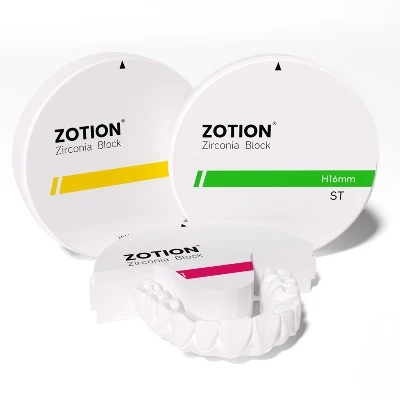
When a dental laboratory orders a zirconia disc, the product usually arrives as a solid, white or slightly off-white blank. It may look like a simple ceramic disc, but its manufacture involves several stages, including powder preparation, granulation, pressing, heat treatment, and quality inspection.
The quality of the finished blank depends not only on the zirconia powder itself but also on how the powder is handled and processed. Even when two manufacturers purchase powder from the same supplier, their finished blanks may differ in density uniformity, machining behavior, and dimensional consistency.
For dental laboratories and distributors, understanding this process helps answer several practical questions:
Why do zirconia blanks from different suppliers behave differently during milling?
Why must manufacturers control the pressing and pre-sintering stages?
What happens if the powder contains large agglomerates or is distributed unevenly?
How can buyers evaluate whether a zirconia manufacturer has reliable production controls?
This article follows the manufacturing process from zirconia powder to a pre-sintered CAD/CAM blank and explains what happens at each stage.
1. Starting With Zirconia Powder
The main raw material used in zirconia blank production is zirconium dioxide, commonly known as zirconia powder.
For dental applications, manufacturers generally use stabilized zirconia powder. Yttria is one of the most common stabilizing agents. Small quantities of other additives may also be included, depending on the powder formulation.
However, receiving a batch of qualified zirconia powder does not mean the manufacturer can immediately press it into a disc.
The powder must have suitable characteristics for the subsequent production stages. These include:
Chemical composition and impurity levels
Particle size distribution
Specific surface area
Degree of agglomeration
Moisture content
Flowability and packing behavior
Compatibility with binders and other processing additives
Each characteristic affects how the powder behaves during mixing, granulation, and compaction.
For example, very fine particles have a relatively large surface area. This can improve sintering activity, but fine powders may also attract one another and form agglomerates. If these agglomerates are not properly dispersed, they can cause uneven packing during pressing.
A powder may therefore have a suitable chemical composition but still present processing difficulties.
Manufacturers need to evaluate both the chemical and physical characteristics of the incoming material.
2. Powder Inspection Before Production
Before processing begins, the manufacturer should check the incoming powder against its technical specifications.
The exact inspection plan depends on the powder supplier and product requirements, but several tests are commonly used.
Chemical composition
Chemical analysis helps identify the main zirconia content, stabilizer content, and possible impurities. Elements such as iron, silicon, sodium, and calcium may require particular attention because unwanted contamination can affect ceramic processing and the properties of the finished material.
The effect of an impurity depends on its concentration and chemical form. Not every trace element will cause a visible defect, but unexplained changes in impurity levels should be investigated.
Particle size distribution
Laser diffraction is commonly used to measure particle size distribution. The results may include values such as D10, D50, and D90.
For example, a hypothetical powder test might report:
D10: 0.15 μm
D50: 0.35 μm
D90: 0.80 μm
These values indicate that 10%, 50%, and 90% of the measured particle volume falls below the respective particle sizes.
The figures above are only an example of how a report may be presented. They are not universal specifications for dental zirconia powder.
The measured particle size also depends on the testing and dispersion method. A laser diffraction result obtained after strong ultrasonic dispersion may differ from one obtained with insufficient dispersion.
Buyers should check the measurement conditions before comparing particle-size figures from different suppliers.
Moisture and storage conditions
Zirconia powder can absorb moisture during storage and handling. Changes in moisture content may affect powder flow, granulation, and binder behavior.
Manufacturers should follow the powder supplier's storage instructions, keep packaging properly sealed, and avoid unnecessary exposure to humid air.
For distributors evaluating a manufacturer, asking how incoming powder is inspected and stored can provide more useful information than simply asking which powder brand is used.
3. Mixing and Slurry Preparation
Some zirconia manufacturing processes use dry powder processing, while others include wet processing.
In a common wet-processing route, zirconia powder is mixed with a liquid medium, usually water, together with suitable dispersants and other additives.
The aim is to produce a relatively uniform suspension, often called a slurry.
At this stage, the manufacturer needs to control several factors.
Solid content
Solid content describes the proportion of zirconia in the slurry by mass.
If the solid content is too low, more liquid must be removed during drying. If it is too high, the slurry may become difficult to pump, mix, or atomize.
The appropriate value depends on the powder characteristics, equipment, and selected formulation.
Dispersion
Zirconia particles can form clusters because of attractive forces between fine particles. A dispersant helps reduce these interactions and improves particle distribution in the liquid.
Mixing equipment, processing time, pH, and dispersant concentration can all influence the result.
A study published in Ceramics International in 2018 investigated the preparation of zirconia suspensions for dental block production. The researchers used a suspension containing 44 wt% zirconia, with distilled water, a pH 2 medium, and 0.5 wt% polyethyleneimine as a dispersant. They compared ultrasonic treatment and ball milling under different conditions before preparing zirconia blocks.
The study illustrates that slurry preparation involves more than adding water and stirring. Dispersion conditions can have a significant effect on the subsequent manufacturing process.
The researchers also investigated cold isostatic pressing as part of the block preparation route. Their findings highlight the relationship between powder dispersion and subsequent consolidation.
These experimental conditions apply to that particular study and should not be treated as a universal production recipe.
Reference: Amat et al., Preparation of presintered zirconia blocks for dental restorations through colloidal dispersion and cold isostatic pressing, Ceramics International, 2018. https://doi.org/10.1016/j.ceramint.2018.01.035
4. Spray Drying: Turning Slurry Into Granulated Powder
After slurry preparation, one common manufacturing route is spray drying.
Spray drying converts the liquid suspension into relatively small, dry powder granules.
The basic process involves several steps:
The prepared slurry is transferred to a spray dryer.
A spray nozzle or atomizing system breaks the slurry into small droplets.
Hot air removes moisture from the droplets.
The dried material is collected as granulated powder.
The granules are screened or otherwise classified when necessary.
Why not press the original fine zirconia powder directly?
Fine ceramic powder does not always flow easily. It may form clusters, bridge across openings, or distribute unevenly when a mold is filled.
Granulation changes the handling behavior of the powder. The resulting granules are generally easier to transport, feed, and distribute during pressing.
Their size and structure also affect the next production stage.
If granules are too large, too hard, or irregularly formed, they may not deform and pack properly during compaction. If they are too weak, they may break down excessively during handling and produce different powder-flow characteristics.
A technical reference on ceramic granulation describes spray-dried zirconia granules in a size range of approximately 20–250 μm. It also explains how granule deformation during pressing helps reduce the spaces between granules.
This is a general ceramic-processing example, not a fixed specification for every dental zirconia blank. The suitable granule size depends on the powder formulation and pressing equipment.
Manufacturers need to monitor more than the average granule size. Granule shape, strength, moisture content, and size distribution also affect the pressing process.
5. Adding Binders and Processing Additives
Granulated zirconia powder may contain organic additives such as binders and plasticizers.
These materials help the powder form a compact body during pressing and give the pressed blank enough strength to be handled before heat treatment.
Without a suitable binder system, the compacted powder may be too fragile. It could crack, chip, or lose its shape during demolding and transfer.
However, adding more binder does not automatically improve the product.
An unsuitable binder amount or uneven distribution can cause problems during heating. Organic materials need to be removed in a controlled way before the zirconia develops its final dense ceramic structure.
Manufacturers must consider the complete processing route when selecting a binder system.
The powder, binder, granulation method, pressing conditions, and thermal schedule all need to be compatible.
Storage time also deserves attention. Changes in moisture or binder condition can affect the handling characteristics of prepared powder before pressing.
6. Forming the Zirconia Blank
Once the powder has been prepared, it can be formed into the required shape.
For dental CAD/CAM products, the finished blank is commonly manufactured as a disc or block. Its dimensions depend on the CAD/CAM system and product range.
Two common forming methods are uniaxial pressing and cold isostatic pressing.
Uniaxial pressing
In uniaxial pressing, powder is placed into a mold and compressed from one direction.
The method is relatively straightforward and suitable for forming products with regular shapes.
However, pressure is applied through the pressing tools. Friction between the powder and the mold wall can contribute to density differences within the compact.
If the powder does not fill the mold consistently, or if the pressing conditions are not properly controlled, the resulting body may have uneven density.
These differences can affect how the blank behaves during subsequent heating and shrinkage.
Cold isostatic pressing
Cold isostatic pressing, commonly called CIP, applies pressure through a liquid medium around a flexible mold.
The powder compact is enclosed in a flexible rubber mold and placed inside a pressure vessel. Hydraulic pressure is then applied from different directions.
Compared with pressing from only one direction, isostatic pressure can help produce a more uniform compact.
A review of dental zirconia processing published in 2024 describes CIP pressures of approximately 200–250 MPa as commonly used in dental zirconia blank production. The exact pressure depends on the powder and manufacturing process.
The same review also points out that manufacturers using powder from the same supplier can still produce blanks of different quality because each manufacturer is responsible for its own compaction process.
For distributors, the distinction is worth noting: a powder supplier's reputation does not automatically guarantee the quality of the finished blank.
The forming process is an independent part of a manufacturer's production capability.
Reference: Recent Advances in Dental Zirconia: 15 Years of Material and Processing Evolution, 2024. https://pmc.ncbi.nlm.nih.gov/articles/PMC11098698/
7. What Happens Inside the Pressed Body?
After pressing, the material is often called a green body or green compact.
At this stage, it is not yet a dense ceramic. It is a compacted structure made up of zirconia particles and, depending on the formulation, organic additives.
Spaces remain between particles and granules. These spaces are known as pores.
Before the next heat-treatment stages, the manufacturer needs to achieve the most uniform particle distribution and packing density possible.
Consider two pressed zirconia discs with the same external dimensions.
The first disc has relatively uniform packing throughout its structure. The second has a dense outer region but contains areas with lower packing density.
Both discs may look similar from the outside, but their behavior during heating may differ.
The less uniform compact can shrink unevenly as the material densifies. In some cases, internal defects may remain even after high-temperature sintering.
A review of dental zirconia processing explains that poorly compacted agglomerates can leave voids in the green body. Some of these defects may not be eliminated during sintering and can remain as poorly densified areas in the final microstructure.
External appearance alone is therefore not enough to assess pressing quality.
For manufacturers, useful controls include:
Green-body weight
External dimensions
Green density
Density variation between sampled positions
Visible cracks or edge damage
Dimensional consistency between production batches
A single density measurement cannot describe the entire production process. Sampling locations and measurement methods also need to be considered.
8. Pre-Sintering: Giving the Blank Enough Strength for Milling
After forming, the green body usually undergoes a controlled heat-treatment process called pre-sintering.
This stage has two main purposes:
Remove organic additives where they are present.
Develop enough bonding between zirconia particles to give the blank suitable strength for handling and milling.
The blank is not yet fully dense. It remains relatively porous and can be machined using dental CAD/CAM equipment.
For this reason, many dental zirconia blanks are described as pre-sintered blanks or soft-milling blanks.
Binder removal
If the powder contains organic binders, they must be removed through a controlled heating schedule.
The heating rate is important.
If organic additives decompose too quickly, gases may be generated faster than they can escape from the compact. This can contribute to internal defects or cracking.
The exact heating schedule depends on the binder chemistry, compact dimensions, and furnace loading.
A large disc and a small laboratory test specimen do not necessarily behave in the same way during binder removal.
Manufacturers should validate the thermal schedule using representative production sizes rather than relying only on small samples.
Developing machinable strength
The pre-sintering temperature also affects the strength and hardness of the blank.
If the blank is insufficiently pre-sintered, it may be fragile during transportation, handling, or milling.
If it is pre-sintered too heavily, its hardness may increase, making machining more difficult.
A technical review of dental zirconia processing describes the common production sequence of powder consolidation, binder removal, and pre-sintering before CAD/CAM milling. The process needs to balance handling strength with machinability.
Published descriptions of conventional dental zirconia processing report pre-sintering temperatures of approximately 1,000–1,100°C in some production routes. The suitable temperature varies with the powder grade and processing method.
These values are examples from established processing methods, not universal temperature settings.
9. Why Does the Blank Shrink During Final Sintering?
By this stage, the zirconia blank has been formed and pre-sintered. It is ready for inspection, packaging, and delivery to the dental laboratory.
The laboratory mills the restoration from the pre-sintered blank and then performs final sintering.
During final sintering, zirconia particles bond more closely together, pores are reduced, and the material becomes much denser.
As the material densifies, its dimensions decrease. This process is known as sintering shrinkage.
For conventional pre-sintered 3Y-TZP systems, published research has reported linear shrinkage in the region of approximately 20–25%, depending on the material and processing conditions.
For example, a dental materials study discussing CAD/CAM zirconia processing reported that a material shrinking by approximately 20% during final sintering would require the milled object to be approximately 25% larger than its intended final size.
The relationship can be illustrated with a simple calculation.
If a restoration needs to finish at 10 mm in a particular direction, a material with 20% linear shrinkage would require an initial dimension of:
10 ÷ (1 − 0.20) = 12.5 mm
This is a simplified example that assumes uniform linear shrinkage.
Actual CAD/CAM systems use the shrinkage information supplied by the material manufacturer. The compensation factor should be based on the manufacturer's validated measurements rather than a general percentage.
For laboratories, consistency is the practical concern.
If different production batches show different shrinkage behavior, the laboratory may experience dimensional deviations even when the same milling settings are used.
Manufacturers therefore need to monitor shrinkage and dimensional consistency across production batches.
10. Inspection of the Pre-Sintered Zirconia Blank
Before a blank is released for sale, it should pass inspection.
The specific inspection plan varies by manufacturer and product, but several checks are particularly relevant to dental laboratories.
Dimensions and weight
The diameter, thickness, and weight of the blank should be checked against the product specification.
For example, a manufacturer producing 98 mm zirconia discs should have a defined dimensional tolerance and a method for recording inspection results.
Buyers should not assume that every supplier uses the same tolerance simply because both products are described as 98 mm discs.
Density and uniformity
Green density or pre-sintered density can provide useful information about the compact.
However, a density value is meaningful only when the measurement method is clear.
Buyers can ask:
Is the reported density measured before or after pre-sintering?
Is it an average value or a result from a specific position?
How often is density checked?
Does the manufacturer keep batch inspection records?
These questions help distinguish a documented quality-control procedure from a general statement that the factory has strict inspection standards.
Machinability
Machinability matters because the blank must be processed by a dental milling machine.
A suitable blank should have enough strength to be handled without being unnecessarily difficult to mill.
Manufacturers can evaluate machinability through controlled milling tests. They may record factors such as milling time, tool wear, surface condition, edge chipping, and the occurrence of cracks.
However, milling results depend on more than the blank itself. The milling machine, burs, toolpath, feed rate, and cooling or dust-extraction conditions can all influence the outcome.
For a meaningful comparison, the test conditions should remain consistent.
Visual inspection
The manufacturer should inspect the blank for visible cracks, chips, contamination, and surface defects.
Visual inspection is useful, but it cannot identify every internal defect.
For more detailed process control, manufacturers may use additional methods such as sectioning, microscopy, or other material-characterization techniques.
The inspection method should match the type of defect being investigated.
11. Why Can Two Manufacturers Produce Different Blanks From Similar Powder?
This is a practical question for distributors.
A zirconia powder supplier may sell the same powder grade to several manufacturers. However, the finished products may not perform identically.
Powder is only the starting material. The subsequent processing stages also influence the finished blank.
Consider the following simplified example.
Manufacturer A and Manufacturer B both purchase zirconia powder with similar chemical compositions and particle-size specifications.
However:
Manufacturer A carefully controls slurry dispersion and granulation.
Manufacturer B has inconsistent granule moisture between production batches.
Manufacturer A checks green-body density at defined sampling positions.
Manufacturer B mainly checks external dimensions.
Manufacturer A validates the pre-sintering schedule using full-size discs.
Manufacturer B uses a heating schedule that has not been adequately evaluated for different disc sizes.
Both manufacturers may use powder from the same supplier, but their process controls differ.
This example is illustrative rather than a report of two actual companies.
It shows why distributors should evaluate the manufacturer's production process, not just the powder brand or chemical composition.
A 2024 review of dental zirconia manufacturing discusses the same issue: manufacturers remain responsible for the quality of the blanks they produce, even when they obtain powder from the same source.
12. What Should Dental Laboratories and Distributors Ask a Zirconia Manufacturer?
Buyers do not need to understand every detail of ceramic processing. However, several practical questions can help them evaluate a supplier.
1. Where does the zirconia powder come from?
Ask for the powder manufacturer's name, grade, and relevant technical documentation.
A supplier should be able to explain whether the powder is purchased as a ready-to-press material or processed further before forming.
2. How is the powder prepared before pressing?
Ask whether the manufacturer uses dry processing, wet dispersion, spray drying, or another preparation method.
No single processing route automatically guarantees a better blank. The key is whether the selected method is suitable for the powder and consistently controlled.
3. What pressing method is used?
Ask whether the manufacturer uses uniaxial pressing, CIP, or a combination of methods.
If CIP is used, the manufacturer should be able to explain how pressing conditions are controlled and monitored.
4. How is pre-sintering controlled?
Ask whether the manufacturer has a validated thermal schedule and whether it checks the properties of pre-sintered blanks.
It is also reasonable to ask how the manufacturer controls binder removal and prevents defects during heating.
5. How is shrinkage measured?
Ask whether the manufacturer provides a batch-specific shrinkage factor or uses a fixed value for every production batch.
A well-controlled process should include a documented method for checking dimensional changes.
6. Can the supplier provide batch traceability?
A batch number should allow the manufacturer to identify the relevant production and inspection records.
This is useful when a laboratory reports a problem with milling, shrinkage, or restoration fit.
The supplier should be able to investigate the specific production batch rather than relying only on general product specifications.
13. The Manufacturer's Responsibility Does Not End With Powder Selection
Producing a dental zirconia blank involves much more than purchasing high-quality powder and pressing it into a disc.
The material passes through several stages, and each one can influence the next.
Powder inspection determines whether the incoming material meets the required specifications. Mixing and granulation affect powder handling and distribution. Pressing determines how the particles are packed into the compact. Pre-sintering removes organic additives where necessary and gives the blank suitable machining strength.
Manufacturers need to manage these stages as one connected production process.
For dental laboratories, the result should be a blank that behaves consistently during milling and final sintering. For distributors, consistent production means fewer unexplained differences between batches and a more reliable basis for supporting customers.
When comparing zirconia suppliers, look beyond the powder brand, stated strength, or price per disc.
Ask how the powder is processed, how the blank is formed, how pre-sintering is controlled, and how the finished product is inspected.
A manufacturer's ability to explain and document these steps provides a much clearer picture of its production capability than a general claim of high quality.